Raising curious, confident learners — one practical answer at a time.
Reading, learning and parenting guidance for families with children aged 0–12. Written by a certified teacher, grounded in the classroom — not recycled internet advice.
Pick a topic
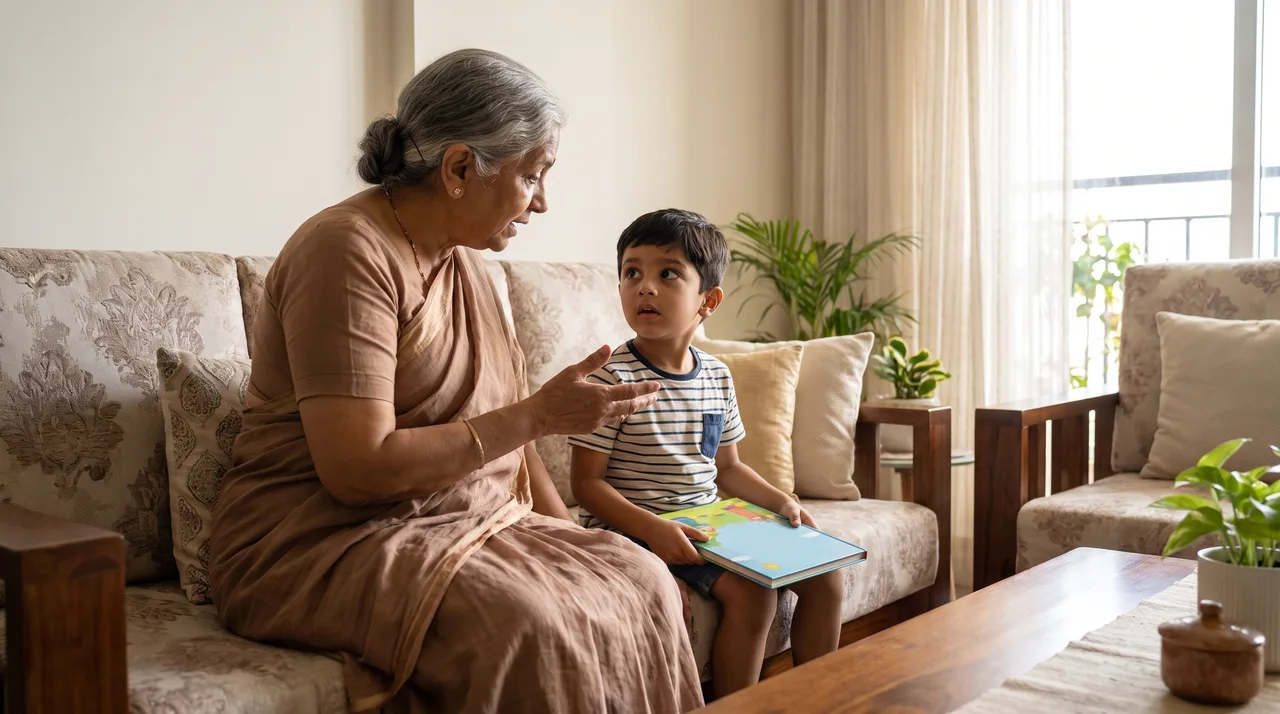
Does Speaking Hindi at Home Affect Your Child’s English Grammar?
Does Hindi at home hurt your child's English grammar? What research shows about bilingualism, mixing languages and what actually helps.
Start reading →Follow a series from start to finish
Some things are better learned in order. Each series is a complete, sequenced course — free, no signup.
Teaching Your Child English Grammar
The grammar-at-home series: how children really learn grammar, and what to do about the everyday mistakes Indian children make.- How to Teach English Grammar to Kids: Hear It, Say It, Build It, Name It
- Is Your Child’s English Mixing in Hindi Grammar? What’s Normal and How to Help
- Does Speaking Hindi at Home Affect Your Child’s English Grammar?
- Is, Am or Are? How to Teach Your Child Which One to Use
- Why Does My Child Skip ‘A’, ‘An’ and ‘The’? How to Teach English Articles to Hindi-Speaking Kids
- How to Teach Tenses to Kids: Talk First, Tense Chart Last
Teaching Your Child to Read
The phonics-first pillar series: how reading actually happens, and how to support it at home.- The Complete Guide to Teaching Your Child to Read: A Phonics-First Approach
- Phonics vs. Phonemic Awareness: Understanding the Difference for Early Readers
- Letter Sounds vs. Letter Names: Why We Teach ‘Ah’ Before ‘Ay’
- Orthographic Mapping: Why Flashcards Are Ineffective for Long-Term Reading
- Blending Sounds: How to Help Your Child Connect C-A-T into “Cat”
- The Continuous Blending Technique: Fixing “Choppy” Sounding Out
- The “Schwa” Sound: Why Kids Struggle to Read Words Like “Banana” and “Water”
- Phonics Books for 4-Year-Olds: What Actually Helps at This Age
- Phonics Books for 5-Year-Olds: Decodable vs. Leveled Readers Explained
- Phonics Books for 6-8 Year Olds: Building Fluency, Not Just Decoding
- Creating a Reading Corner: How to Design a Space That Encourages Book Use
- What Are Decodable Books? Why Beginners Need Books Without Tricky Words
- Finger Tracking: Why New Readers Need to Point at Words While Reading
- Listening Games for Kids: Building the Skills That Come Before Reading
- The Importance of Nursery Rhymes: How Rhyme and Rhythm Feed Reading
- The ‘I Spy’ Sound Game: Teaching First Sounds at Home (Without Teaching It Wrong)
- Labeling Household Objects: Does Taping Words to the Fridge Help Reading?
- Sportscasting for Parents: Narrating Your Day to Grow Your Child’s Words
- The Word Gap: What “30 Million Words” Gets Right, and Wrong
- Reading Aloud: Why Quizzing Your Child Can Backfire at Storytime
- Heart Words: How to Teach Words That Can’t Be Sounded Out
- High-Utility Letters: Why You Should Teach S, A, T, P Before B, C, D
- Early Signs of Dyslexia in Preschoolers: What to Look for Beyond Reading
New on the Journal
Phonics Books for 5-Year-Olds: Decodable vs. Leveled Readers Explained
Decodable and levelled readers sit side by side on the shelf and teach opposite habits. One builds sounding out; the other quietly rewards guessing from the pictures.
Phonics Books for 4-Year-Olds: What Actually Helps at This Age
Four-year-olds don't need reading books yet — they need sound play. Here's what actually helps at this age, and the six books we'd put on the shelf.
What Is NIPUN Bharat? A Parent’s Guide to FLN
India's national mission says every child should read fluently with comprehension by Class 3. Here's what that target actually means, where the numbers come from, and how to tell if your child is on track.
The “Schwa” Sound: Why Kids Struggle to Read Words Like “Banana” and “Water”
A phonics-taught child sounds out "banana" with three clear vowels. Native speakers use two reduced ones. The schwa isn't a phonics failure — it's a real gap worth naming.
The Continuous Blending Technique: Fixing “Choppy” Sounding Out
Your child sounds out every letter correctly but still can't say the word. Choppy sounding-out has a specific, well-studied fix: connected phonation.
Blending Sounds: How to Help Your Child Connect C-A-T into “Cat”
Your child knows every letter sound in "cat" but can't read the word? That's blending, not phonics knowledge — and it's a routine you can teach tonight.
Orthographic Mapping: Why Flashcards Are Ineffective for Long-Term Reading
Words become instant not through memorising shapes but through sounding out — a brain process called orthographic mapping. Why flashcard drilling hits a ceiling, and what builds a permanent word bank instead.
Letter Sounds vs. Letter Names: Why We Teach ‘Ah’ Before ‘Ay’
'See-ay-tee' will never blend into 'cat'. Why reading is built from letter sounds, not the alphabet song — and how to add the sounds if your child learned names first.
Phonics vs. Phonemic Awareness: Understanding the Difference for Early Readers
One is ears-only, one needs print — and mixing them up sends months of practice at the wrong target. How to tell which skill your child actually needs, with tonight-ready checks.
The Complete Guide to Teaching Your Child to Read: A Phonics-First Approach
The evidence-based, no-gimmick roadmap for teaching your child to read: what phonics is, why it works, what to do at each age, and the traps that quietly teach guessing instead.
Get one useful tip a week
Written by Monika. No spam, no daily emails — just what's worth your five minutes.