Heart Words: How to Teach Words That Can’t Be Sounded Out
Your child breezes through "cat" and "sun," then stalls on "said." Here is exactly which part of a heart word to sound out, which part to learn by heart, and a five-minute routine to teach the difference.
- A heart word usually has one regular part and one irregular "heart" part, not a whole unreadable word.
- Sound out the regular letters first, then just memorise the one irregular piece.
- Keep the active list small: five or six words at a time, not twenty.
- Most heart words stop being exceptions once your child learns the pattern behind them, later on.
Your child breezes through “cat,” “sun,” and “lamp” — then stalls cold on “said.” That’s not a decoding failure. It’s a heart word: what Jolly Phonics calls a “tricky word,” a word with one or two letters that don’t follow a rule your child has been taught yet, sitting inside letters they already know. Here’s exactly which part to sound out, which part to learn “by heart,” and how to teach the difference — this is one piece of the full picture in our phonics-first guide, building on the mapping skill in our orthographic mapping guide.

What’s a heart word, exactly?
Take “said.” Your child can already sound out s and d — those are regular, taught sounds. The middle, ai, is the problem: it spells /e/ here, not the long-a sound it usually makes. That one piece is the “heart” part — the bit with no rule to fall back on yet, so it gets circled, named, and memorised on its own, while the rest of the word is sounded out exactly like normal. A few more, broken down the same way:
- of — sound out o; the heart part is f, which says /v/ here instead of its usual sound.
- you — sound out y; the heart part is ou, spelling a long /oo/ instead of its taught sound.
- was — sound out w; the heart part is as, which says something closer to ‘woz’ than its regular sound.
- could — sound out c and d; the heart part is oul, with a silent l.
- one — the honest outlier: only the n is regular. Everything else about this word is heart. Worth naming out loud, so your child isn’t thrown when the trick doesn’t split evenly every time.
No flashcards required — a whiteboard, a highlighter, and five minutes is enough.
Pick words your child is actually meeting in a book or worksheet this week, not a random list off the internet.
One rule for you: never let your child guess the whole word from the picture or the first letter. Sound the regular part every time, out loud, together.
Does sounding it out even work on a word like “said”?
Yes — for most of the word. Reading researcher Linnea Ehri (2014) describes this as orthographic mapping: a reader bonds a word’s spelling to its sound using whatever regular letter-sound connections it contains, then tags the leftover part as a one-off exception. A heart word isn’t stored as a picture of its shape — it’s stored as a normal phonic map with one flagged exception, which is exactly why sounding out the regular letters first still matters, even on a word that can’t be fully decoded. It’s the same mapping process our orthographic mapping guide covers for fully regular words — heart words just add one irregular tag to an otherwise ordinary map.
- Child memorises the whole shape of “said” as one unit
- No transfer to the next new tricky word, like “again”
- Breaks down under stress, in a new font, or out of context
- Child sounds out *s* and *d* normally, and marks only *ai* as the one part to remember
- The routine transfers — every new heart word gets the same two-step treatment
- Holds up, because most of the word was never a guess to begin with
What’s the five-minute heart-word routine?
This is the same shape of routine structured-literacy teaching materials call “Heart Word Magic” and what Jolly Phonics has always done under the name “tricky words” — mark only the irregular part, sound out the rest like any other word.
- Spot the regular part
Say the word slowly. Which letters make a sound your child already knows? Underline those.
- Mark the heart
Circle or heart the one or two letters left over — the part with no rule to fall back on yet.
- Say it in two pieces
“s… ai (heart)… d.” Sound the regular letters, then simply name the heart part.
- Write it three times
Writing rebuilds the same spelling-to-sound link that reading does. Say each letter name as your child writes it.
- Meet it in a sentence
Read one real sentence containing the word, the same day. A word learned in isolation and never met again rarely sticks.
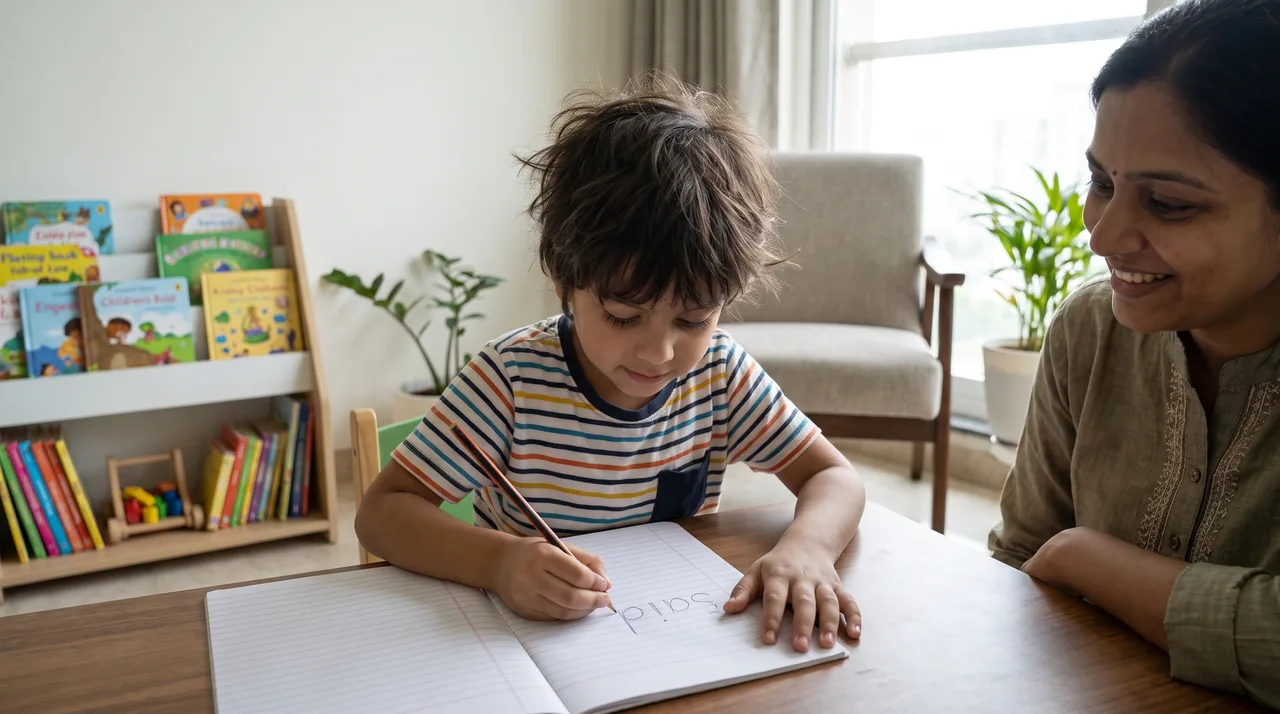
Keep the “heart” pile small — five or six words active at a time, not twenty. Federal reading guidance from the U.S. Institute of Education Sciences (2016) is specific on this: too many unpatterned words introduced at once overloads memory faster than it builds it.
How does this change as my child gets older?
Early on, most of a heart word feels arbitrary. As your child learns more spelling patterns, some of that irregularity resolves itself — the ai in “said” eventually gets explained once they meet other ai-as-/e/ words, and what looked like a permanent exception turns out to be an early pattern they hadn’t been taught yet. This is the consolidation stage our orthographic mapping guide describes — by age seven or eight, most children need this routine less often, because fewer words are still genuinely exceptional to them.
Is this different in a Hindi-speaking home?
Honestly, there isn’t dedicated research on heart words specifically for Hindi-first learners — worth saying plainly rather than inventing a connection that doesn’t exist. What we do have is a 2024 randomised-control trial with Grade 2 students in Indian English-medium schools, which found real gains in sound-symbol knowledge from structured phonics instruction generally, though the gains didn’t always transfer cleanly to independent reading outside the practice activity — a fair caveat, not a reason to skip the routine. One thing worth watching for, as a hypothesis rather than a settled finding: children moving between Hindi and English sound systems sometimes merge /v/ and /w/, which could make heart words like “was,” “were,” or “one” a little stickier than others. If you notice that pattern, it’s worth a mention at your child’s next class, not a cause for concern on its own.
“The children who struggle with tricky words are almost always the ones drilling the whole word as one shape. The moment I show a parent to just heart the one letter and sound the rest like normal, the guessing stops within a week.” Monika Verma — Lead Trainer, LittleLearns

How do I know it’s actually working?
Spot which letters in a heart word they can still sound out normally
Name the one or two letters that are the “heart” part, without being prompted
Use the same two-step routine on a brand-new heart word they haven’t seen before
Read 15 to 20 common heart words correctly inside real sentences, not only in isolation
Parents also ask
- Ehri, L. C. (2014). Orthographic mapping in the acquisition of sight word reading, spelling memory, and vocabulary learning. Scientific Studies of Reading, 18(1), 5-21 (retrieved September 2026)
- Really Great Reading. Heart Word Magic: a research-aligned way to teach high-frequency words (retrieved September 2026)
- Institute of Education Sciences (2016). Foundational skills to support reading for understanding in kindergarten through 3rd grade (WWC Practice Guide) (retrieved September 2026)
- Department for Education and Skills, UK (2007). Letters and Sounds: Principles and Practice of High Quality Phonics (retrieved September 2026)
- Schwartz, S. (2025). Does teaching “sight words” contradict the science of reading? Education Week (retrieved September 2026)
- Bora, S., Patel, P., Psyridou, M., Ruotsalainen, J., Richardson, U., & Torppa, M. (2024). Foundational English literacy development in India: a randomised-control trial using phonics instruction and GraphoLearn. Reading and Writing (retrieved September 2026)
Every child develops at their own pace — see our learning-outcomes note. This routine is a teaching technique, not a substitute for your child’s own reading program.
Early Signs of Dyslexia in Preschoolers: What to Look for Beyond Reading
8 min readHigh-Utility Letters: Why You Should Teach S, A, T, P Before B, C, D
8 min read
Reading Aloud: Why Quizzing Your Child Can Backfire at Storytime
9 min read
The Word Gap: What “30 Million Words” Gets Right, and Wrong
12 min readExplore the Journal
Teaching Your Child English Grammar
The grammar-at-home series: how children really learn grammar, and what to do about the everyday mistakes Indian children make. 6 articlesTeaching Your Child to Read
The phonics-first pillar series: how reading actually happens, and how to support it at home. 23 articlesGet one useful tip a week
Written by Monika. No spam, no daily emails — just what's worth your five minutes.