The “Schwa” Sound: Why Kids Struggle to Read Words Like “Banana” and “Water”
A phonics-taught child sounds out "banana" with three clear vowels. Native speakers use two reduced ones. The schwa isn't a phonics failure — it's a real gap worth naming.
- The schwa (/e/) is a soft, unstressed "uh" sound — and it’s the single most common vowel sound in English.
- It breaks the letter-sound rules on purpose: any vowel letter can represent it, which is why sounding "banana" out phonetically gives the wrong pronunciation.
- It only appears in unstressed syllables of longer words — never in one-syllable words, and never in a stressed syllable.
- The fix isn’t more phonics drilling — it’s explicitly naming the schwa as its own sound once a child is decoding two-syllable words.
A child who has been taught phonics properly — every letter sound solid, blending smooth — sounds out “banana” and says something like “ban-AN-ah” with three clear, distinct vowel sounds. A native speaker says “buh-NAN-uh,” with two of those three vowels reduced to almost nothing. Your child didn’t get it wrong. English did. The culprit is a single sound that doesn’t officially have its own letter, shows up constantly, and breaks the very rules phonics just taught: the schwa — a later-stage wrinkle in the approach laid out in our complete phonics-first guide.
The short answer
SchwaThe soft, unstressed “uh” vowel sound that any vowel letter can represent — the most common vowel sound in English, and the least predictable to spell or sound out. is a soft, reduced “uh” vowel sound that appears only in the unstressed syllables of longer words — the second syllable of “banana,” the first syllable of “about,” the last syllable of “pencil.” It’s the single most common vowel sound in English, and also the least phonics-friendly: any vowel letter — a, e, i, o, or u — can represent it, so sounding a word out letter by letter often produces a pronunciation nobody actually uses. This isn’t a phonics failure. It’s a real, well-documented gap between the code your child was taught and how English is actually spoken.
Why “banana” breaks the rules on purpose
Phonics instruction is built on a genuinely reliable idea: letters represent predictable sounds, and sounding them out gets you the word. That system works beautifully for stressed syllables. It runs into trouble the moment a syllable is unstressed — because English speakers don’t give unstressed vowels their full, textbook sound. They flatten it. Whatever letter is sitting in that unstressed spot — a, e, i, o, u — comes out sounding like the same soft “uh,” regardless of which vowel is actually printed.
Literacy researcher Louisa Moats, whose Speech to Print is a standard teacher-training reference on English’s sound system, describes schwa as “an emptied out vowel, a sound with the stuffing taken out of it” — and estimates it accounts for roughly a fifth of all vowel sounds spoken in English (Moats, Speech to Print). That frequency is exactly why it matters for early readers: it isn’t a rare exception children can memorise a handful of times and move on from. It’s baked into an enormous share of the multisyllable words a fluent reader needs.
A mother once brought in her son — let’s call him Kabir, seven — worried that his phonics had “stopped working” because he’d started mispronouncing words he used to get right, things like “camera” and “elephant.” His phonics hadn’t broken at all. He’d just reached the point in his reading where multisyllable words with a schwa started showing up, and nobody had told him that one sound in the middle sometimes just goes soft and quiet. Once we named it — “that’s the lazy sound, it can hide in any vowel” — he adjusted within a week.
Monika Verma — Lead Trainer, LittleLearns

Spelled five different ways, said the same way
The clearest way to see why this trips readers up is to look at the same sound hiding under every vowel letter in turn. Say each of these words aloud and listen to the bolded syllable — it’s the identical soft “uh” every time, no matter which letter is spelling it.
That’s the whole difficulty in one table: five different printed letters, one identical spoken sound. A child sounding words out with fresh, literal phonics logic has every reason to expect five different vowel sounds — and gets a rule-breaking surprise instead.
How to actually teach it
The fix isn’t more phonics drilling on the “correct” letter sound — the letter sound genuinely isn’t what’s being spoken, so drilling it just produces a mismatch between practice and real speech. The fix is naming schwa directly, once your child is decoding two-syllable words and hitting real confusion.

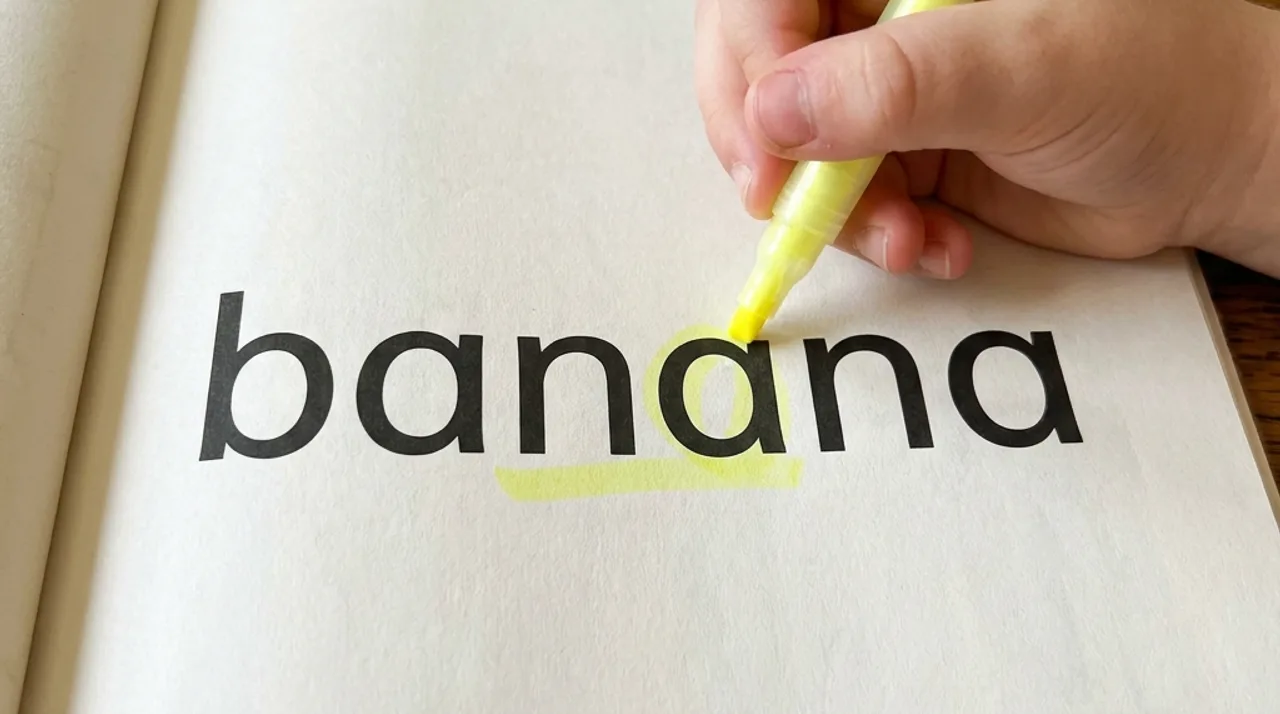
Pick a familiar two-syllable word with a schwa your child already says correctly in speech — “banana” or “pizza” work well because they’re common and food-related.

Clap the syllables, then say the word slowly, exaggerating the stressed syllable and softening the unstressed one: ba-NA-na.

Name the soft sound directly — “that quiet ‘uh’ in the middle is called schwa, and it can hide behind any vowel letter.”

Try a few more familiar words together and ask your child to point to which syllable has the “lazy” schwa sound.
Keep the label playful rather than technical at first — “the lazy sound” or “the quiet uh” works better with young children than the linguistic term. The goal isn’t for your child to spell using schwa rules (that comes later, and even adults get schwa spellings wrong constantly, which is exactly why words like “separate” and “definitely” are common misspellings). The goal at this stage is just recognition: knowing that a syllable can sound different from what its letter would predict, and that this is normal, not a mistake. Schwa is one piece of the broader multisyllable-decoding work that defines this stage — see our guide to phonics books for 6-8-year-olds for the full picture.
Naming schwa explicitly once your child is reading two-syllable words, rather than letting it stay an unexplained exception. Using words your child already says correctly in speech as the starting examples — the goal is connecting known speech to new print, not teaching new pronunciation. Treating it as a normal feature of English, not a mistake to fix.
Insisting on the “textbook” vowel sound when sounding a schwa word out — “buh-AN-AH-nuh” isn’t how anyone actually says “banana,” and drilling it teaches a pronunciation nobody uses. Introducing schwa before your child is comfortably decoding two-syllable words — see orthographic mapping for what “comfortably decoding” should look like first. Treating every reading slowdown as a schwa issue — most early reading hesitation is ordinary blending practice, not this.
Say “banana” slowly and ask your child which syllable sounds the quietest or “laziest.”
Try the same with “elephant,” “pencil,” and “circus” — is it always the unstressed syllable, wherever it falls?
Ask your child to guess what letter is “really” printed in that quiet syllable, then show them — it’s often a surprise.
Milestones from the curriculum
Read words like “rabbit,” “thunder,” “fantastic” by breaking them into syllable chunks and blending
Clap or tap syllables in a multi-syllable word, then read each chunk before blending
Identify that every syllable must contain a vowel sound
Ask Mrs. Monika: quick answers
- Moats, L. C. Speech to Print: Language Essentials for Teachers (3rd ed.). Brookes Publishing (retrieved August 2026)
- National Reading Panel (2000). Findings — Report of the National Reading Panel (retrieved August 2026)
Every child develops at their own pace — see our learning-outcomes note. Names of children in this article have been changed. Want your child’s multisyllable reading checked properly? The free 20-minute demo class includes exactly this kind of check.