How to Teach English Grammar to Kids: Hear It, Say It, Build It, Name It
Your child can name a noun and still write "She don't like it". Why rules alone don't stick, and the four-step loop that does: hear it, say it, build it, name it.
- Children learn grammar by hearing, saying and building sentences; the rule is a name that comes last.
- Teaching grammar as separate rules has not been shown to improve writing; sentence combining has the best support.
- A ten-minute loop at home: hear it, say it, build it, name it.
- Hindi-influenced mistakes are normal, and each has a simple school form.
Your child can tell you a noun is a naming word. Then they write “She don’t like it” and never notice. If that sounds familiar, the order grammar is taught in may be part of the cause. It is not your child, and it is not a lack of practice.
This guide covers how to teach English grammar to kids aged 6 to 12: what works at home, what does not, and what NCERT’s own syllabus says. Where we have a deeper guide, the section links to it. It is long, so bookmark it and dip in. It draws on research and on more than ten years of teaching at Little Learns. Monika Verma (Jolly Grammar Levels 1 to 6) has taught grammar there to more than 500 children, in Zoom groups of up to six.

The 30-second version
Children do not learn grammar mainly from rules. They learn it by hearing correct sentences many times, saying their own, and building longer ones out of shorter ones. The rule comes last, as a name for something the child can already do. Reviews of writing research found no reliable gain from traditional grammar teaching, and NCERT’s own elementary English syllabus calls teaching isolated grammatical items “largely unnecessary and futile”. Our alternative is a short daily loop: hear it, say it, build it, name it. We suggest about ten minutes. The Hindi patterns your child carries into English are normal, and most have a fix you can use tonight.
Why does my child know the rules but still get it wrong?
Because knowing a rule and using a rule are two different skills. A child can chant “a verb is a doing word” and still say “he don’t know”, because speech runs on patterns absorbed by ear, far faster than any rule can be recalled. The rule lives in the classroom. The habit lives in the ear. Worksheets train the first and do very little for the second.
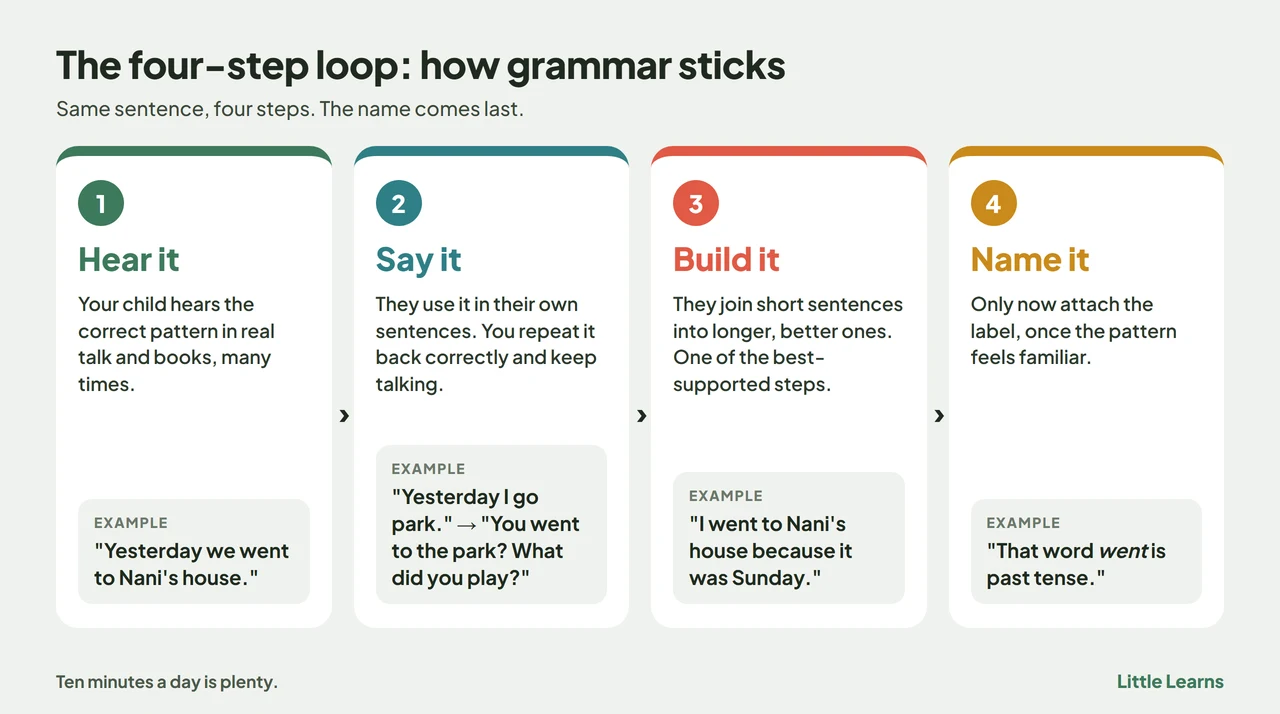
Your child hears the correct pattern many times, in real talk and in books, before anyone asks them to use it. “Today is Tuesday. Yesterday was Monday.” No lesson, just the sentence.
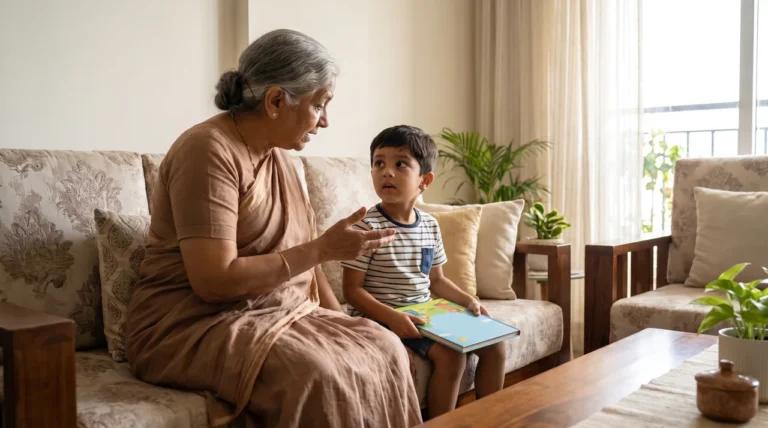
They use the pattern in their own sentences about their own day. When it comes out wrong, you say it back correctly and carry on the conversation. No stopping, no “no, say it again”.
They make sentences longer and better: joining two short sentences into one, adding a describing word, adding a “because”. Sentence combining is the grammar-related step with the best research support: an effect size of 0.50 in one large review.
Only now do you attach the label: “That word is a verb”, “That was past tense”. A name is useful once a child can already do the thing it names.
Much homework help runs this loop backwards. It starts with the name and the rule, and hopes the ear catches up. Flip it and the same ten minutes goes much further. In our small Zoom groups every child says their own sentences aloud before anyone writes or labels anything: ear first, name last.
What does the research say about teaching grammar?
The research backs what many parents see at the kitchen table. A 2007 meta-analysis of writing instruction by Graham and Perin (Journal of Educational Psychology) pooled 123 studies and reports on children in Grades 4 to 12. Traditional grammar teaching came out slightly negative (an average effect of −0.32). Teaching children to combine short sentences into longer ones came out clearly positive (0.50). A 2006 systematic review by Andrews and colleagues, covering ages 5 to 16, found “little evidence” that teaching formal grammar improves writing, though the research was not strong enough to settle it either way. A 2012 review of writing instruction in the elementary grades (Graham and colleagues) found no significant effect from grammar instruction. All three are about traditional or formal grammar teaching, and none says grammar does not matter.
Two limits to know. Most of this research studied children aged 9 and up, writing in their first language, so for ages 6 to 8 the talk-first approach rests on NCERT’s syllabus and classroom practice. And for second-language learners, a 2000 review by Norris and Ortega (mostly teenagers and adults) found explicit instruction more effective than implicit instruction. That is why this guide keeps a short “name it” step instead of dropping grammar terms.
Another approach weaves grammar into real writing, through talk and playing with sentences. A 2012 trial across 31 English schools (Myhill and colleagues) found a significant gain for 744 twelve- and thirteen-year-olds. How much it helped depended on how well the teacher knew the grammar. That is why this guide gives you the moves, not just the theory.
India’s own syllabus lands in the same place. NCERT’s elementary English syllabus (from the NCF-2005 era) says that “children have an innate faculty to construct grammatical systems on their own” and that grammars “would emerge from an active engagement in communicative practices”. At the primary stage, it describes grammar as “a process of discovering uses and functions of items” through what children hear and read. At the upper primary stage it asks for a conscious effort to name grammatical items, but says they “should not be taken out of contexts to be treated as discrete teaching items”.
Do grammar worksheets help?
Worksheets help as a check, not as the teacher. A worksheet is a good check: does your child get this pattern right when they stop and think? It is a poor teacher. A quick test: if your child gets the worksheet right but still says it wrong at dinner, go back to steps one and two. More worksheets will not close that gap. Your child will still get worksheets at school, so do them, then spend two minutes saying the sentences aloud.
When is a child ready for formal grammar?
A child is ready for grammar labels when they read simple sentences comfortably and can talk in full sentences about what happened, not at a set age. Grammar builds on reading, so a child still working on sounding out words needs the phonics-first reading foundation before any grammar terms. Short sentences are where reading and grammar meet. A child who reads “The cat sat on the mat” has just met a subject, a verb and a preposition without a single label.
Short decodable passages that take a child from reading three-letter words to reading whole sentences. It is the reading bridge before grammar begins, for ages 3 to 6.
View in shopWhat grammar mistakes do Indian kids make, and should you correct them?
Most of them are Hindi (or Tamil, Bengali, Marathi) patterns carried into English. Hindi has no separate word like “the”, so it is dropped. Hindi uses one word for he, she and it, so they get mixed up. Hindi questions keep normal word order, so “What you are doing?” feels right. None of this is carelessness, and most of it is also part of the Indian English spoken around your child. Our guide to the mistakes Indian kids make sorts the typical patterns from the ones worth a closer look, with the school-correct form beside each one. If the worry is bigger, whether speaking Hindi at home is causing the problem, our answer is on how bilingualism affects English grammar.
As for correcting: not every mistake, because correcting everything can make a child stop talking. Recasting means repeating what your child said in the correct form as part of the conversation, without asking them to say it again. Your child says, “She don’t like it.” You say, warmly, “Oh, she doesn’t like it? Why not?” Or your child says, “Yesterday I go to the market.” You say, “Oh, you went to the market yesterday? What did you buy?” They have heard the correct form, in context, and the conversation kept going. Pick one pattern a fortnight to model gently, not five at once. Nothing here has to be fixed this month.
Which tiny words cause the most trouble, and what fixes each?
A handful of small words account for many everyday slips, and each has a fix that has nothing to do with a chart.
- Is, am, are. Hindi’s hona already changes with the person (hoon, hai, hain), so your child only needs the English words. See when to use is, am and are.
- Has, have, had. “Has” goes with he, she and it, “have” with I, you, we and they, and “had” is for the past. Children often mix them up because the form changes with both person and time. Say the pair aloud in real sentences (“She has a pencil. They have pencils.”) and repeat slips back correctly.
- A, an, the. Hindi has no articles, so these often arrive late and need patience. See how to teach articles to kids, with a two-question test and a free card.
- Singular and plural. “Childrens” is a sign of a child applying the plural rule, which is progress. Reply, “Yes, two children!” and move on.
How do you teach tenses without a tense chart?
Teach tenses by talking about time, every day, in the right tense, long before you say the word “tense”. “We are eating lunch now.” “We ate breakfast early.” “Tomorrow we will go to Nani’s house.” The child hears the three shapes in situations they care about. After a few weeks of this, the chart becomes a summary of something they already know instead of a list to memorise. Our six-week plan for teaching tenses spells out the sequence, with a printable.
Sentence combining: the two-minute habit that works
Sentence combining, joining two short sentences into one better one, is the grammar-related step with the best research support (an effect of 0.50 in the Graham and Perin review), and it takes two minutes. You give your child two short sentences and ask them to make one better sentence out of them. There is no single right answer, so nobody feels tested.
- “The dog barked. The dog was big.” → “The big dog barked.”
- “I was late. The bus broke down.” → “I was late because the bus broke down.”
- “Riya ran home. Riya was scared.” → “Riya ran home because she was scared.” (or “Scared, Riya ran home.”)
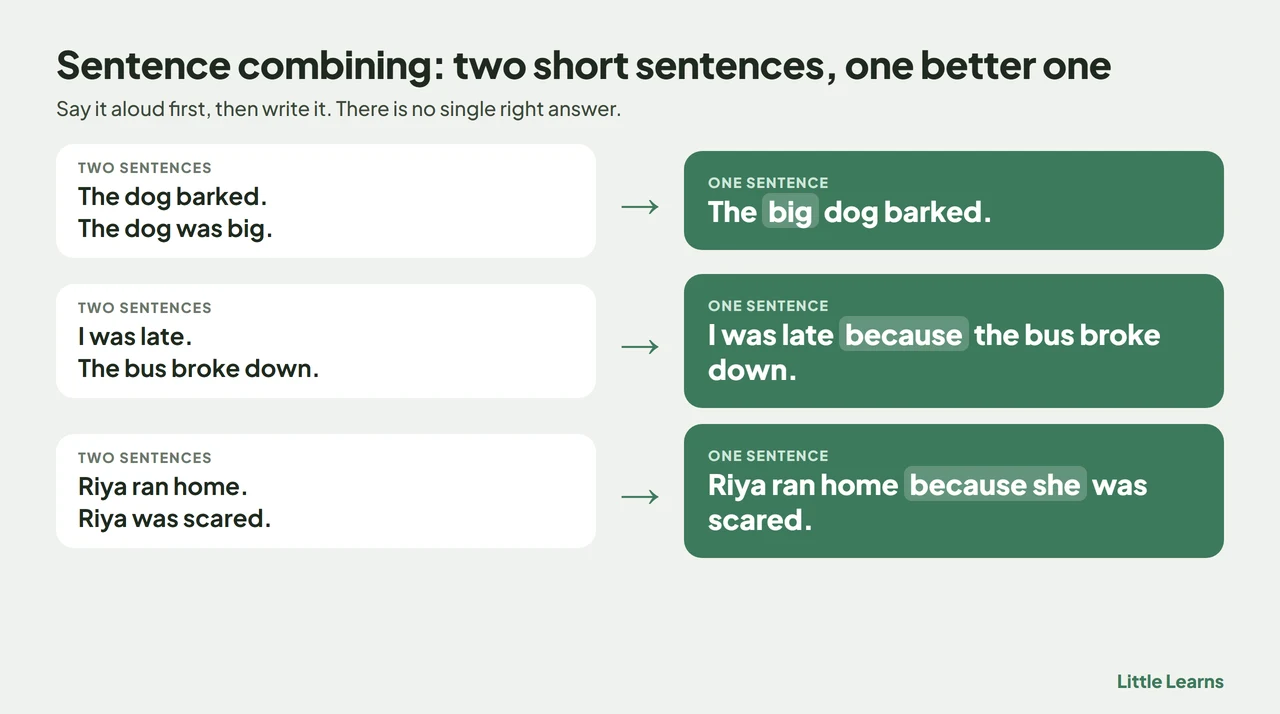
Start with two sentences a day, said aloud, and then written. In one classroom study of fourth-graders by Saddler and Graham (2005), children who practised sentence combining with a partner got better at building complex sentences and used the skill when revising their own stories. The comparison group got grammar instruction instead.
Punctuation and parts of speech come later
Punctuation and parts of speech come easier once a child is reading and building sentences. Capital letters, full stops and commas are best learned by noticing them in read-aloud books and then choosing them in their own writing. Try it: read a page aloud and ask your child to spot the capital letters and full stops before you turn it over. Parts of speech (noun, verb, adjective) are labels, so they belong in the “name it” step.
How do you teach English grammar to kids in ten minutes a day?
Here is a routine you can run on any evening, with no printouts. It uses all four steps and should not feel like homework.
- Minutes 1 to 3, hear it. Read a page aloud from a book your child likes. Stop once and point out one sentence you enjoyed: “Listen to this one.”
- Minutes 4 to 6, say it. Ask about their day: “What did you do at school today?” Recast any slip, then keep talking.
- Minutes 7 to 9, build it. Give two short sentences to combine, first aloud, then written. Try one pair from the book and one from their day.
- Minute 10, name it (only sometimes). If a word came up naturally, say its name once: “Did you notice because joined the two ideas?” Skip this step if it feels forced.
What does each age need, and how do you know your child is on track?
Ages 6 to 8 need talk and stories, ages 9 to 10 need steady tenses and sentence joining, and ages 11 to 12 add prepositions, voice and reported speech. These are centres of a range, not deadlines.
- Ages 6 to 8 (Class 1 to 3)
Talk and stories, lots of them. Capital letters and full stops in read-alouds, a/an by sound, one and many, past and present.
- Ages 9 to 10 (Class 4 to 5)
Tenses kept steady in writing, joining sentences with “and”, “but” and “because”, commas in lists, the first labels (noun, verb, adjective).
- Ages 11 to 12 (Class 6 to 7)
Prepositions, active and passive voice, direct and indirect speech, paragraph flow. For this age, turn the loop towards their own writing: ask them to read a paragraph aloud and fix any sentence that sounds wrong before you point to it.
Your child is on track when they can do these things in sentences they made up themselves, not when worksheet scores are high. These checkpoints come from a public curriculum map. Use them as a rough guide and expect wide variation.
Write or spot a statement, question, exclamation and command, and pick the right end mark for each (ages 6 to 7)
Use “a” before consonant sounds and “an” before vowel sounds, including tricky ones like “an hour” and “a uniform” (ages 7 to 8)
Write “The dog runs” and “The dogs run”, and fix “The children plays” (ages 6 to 8)
Say and write “went” instead of “goed”, “saw” instead of “seed” (ages 7 to 8)
Keep one tense steady through a whole short story, and spot a slip like “Yesterday she walks to the shop and bought milk” (ages 8 to 9)
Join two ideas with “because”, “but” or “so” in their own writing (ages 6 to 9)
Use the terms noun, verb and adjective when talking about their own sentences (ages 8 to 10)
Explain the difference between active and passive voice, and use each on purpose (ages 10 to 12)
Do you need a grammar book? Four that help
You do not have to buy a book: NCERT’s English readers are free to download, and any library book works for step one. A good workbook does give you tidy practice for step three and a clear check at the end. Used well, it gives you ready-made examples to talk through. Four that suit the ages in this guide are in our shop.

A grammar book-cum-workbook with 500-plus concept-building exercises, answers included, across 136 illustrated pages. Good for step three, once your child can already say the pattern.
View in shop
A graded series that puts the emphasis on applying rules correctly, not on memorising them, which fits the talk-first approach in this guide.
View in shop
Friendly animal characters guide children through describing phrases, plurals, possessives and paragraphs, with clear practice pages.
View in shop
Reading and writing together, so grammar shows up inside real passages.
View in shopTwo more are worth knowing. We do not stock them, so they link to Amazon.in.
A short 32-page practice book from the Collins Easy Learning range, covering grammar and punctuation with clear examples.
View on Amazon.inA grammar and composition course listed under CBSE books and written for Indian classrooms, so it matches what many schools set.
View on Amazon.inAs an Amazon Associate, Little Learns earns from qualifying purchases. Links marked Amazon.in are affiliate links; the price to you is the same.
बच्चे नियम रटकर व्याकरण नहीं सीखते। वे सही वाक्य बार-बार सुनकर, खुद बोलकर और छोटे वाक्यों को जोड़कर सीखते हैं। संज्ञा, क्रिया जैसे नाम सबसे आख़िर में आते हैं। रोज़ दस मिनट काफ़ी हैं। हिंदी की आदत से आई ग़लतियाँ सामान्य हैं: बच्चे को टोकने के बजाय सही वाक्य बातचीत में दोहरा दें।
“I teach grammar in groups of no more than six children, so every child gets to speak. Ear first, name last: they hear the pattern, say it, build with it, and only then learn what it is called. When a parent tells me their child knows the rules but writes it wrong, I ask one thing: does your child say it correctly? If they do, the rule is not the problem.” Monika Verma, Lead Trainer, Little Learns (Jolly Grammar Levels 1 to 6, 2023)
Questions parents ask most
- Graham, S., & Perin, D. (2007). A meta-analysis of writing instruction for adolescent students. Journal of Educational Psychology, 99(3), 445-476 (retrieved 2026-09-30)
- Andrews, R., Torgerson, C., Beverton, S., et al. (2006). The effect of grammar teaching on writing development. British Educational Research Journal, 32(1), 39-55 (retrieved 2026-09-30)
- Saddler, B., & Graham, S. (2005). The effects of peer-assisted sentence-combining instruction on the writing performance of more and less skilled young writers. Journal of Educational Psychology, 97(1), 43-54 (retrieved 2026-09-30)
- NCERT. Syllabus for Classes at the Elementary Level: English (Classes I-VIII) (retrieved 2026-09-30)
- Graham, S., McKeown, D., Kiuhara, S., & Harris, K. R. (2012). A meta-analysis of writing instruction for students in the elementary grades. Journal of Educational Psychology, 104(4), 879-896 (retrieved 2026-09-30)
- Norris, J. M., & Ortega, L. (2000). Effectiveness of L2 instruction: a research synthesis and quantitative meta-analysis. Language Learning, 50, 417-528 (retrieved 2026-09-30)
- Sharma, D. (2005). Language transfer and discourse universals in Indian English article use. Studies in Second Language Acquisition, 27(4), 535-566 (retrieved 2026-09-30)
- Myhill, D., Jones, S., Lines, H., & Watson, A. (2012). Re-thinking grammar: the impact of embedded grammar teaching on students’ writing and students’ metalinguistic understanding. Research Papers in Education, 27(2), 139-166 (retrieved 2026-09-30)
Every child learns at their own pace: see our learning-outcomes note. This guide is general parenting information, not a professional assessment.
Does Speaking Hindi at Home Affect Your Child’s English Grammar?
12 min read
Why Does My Child Skip ‘A’, ‘An’ and ‘The’? How to Teach English Articles to Hindi-Speaking Kids
10 min read
How to Teach Tenses to Kids: Talk First, Tense Chart Last
10 min read
Is, Am or Are? How to Teach Your Child Which One to Use
9 min readExplore the Journal
Teaching Your Child English Grammar
The grammar-at-home series: how children really learn grammar, and what to do about the everyday mistakes Indian children make. 6 articlesTeaching Your Child to Read
The phonics-first pillar series: how reading actually happens, and how to support it at home. 23 articlesGet one useful tip a week
Written by Monika. No spam, no daily emails — just what's worth your five minutes.