What Is NIPUN Bharat? A Parent’s Guide to FLN
India's national mission says every child should read fluently with comprehension by Class 3. Here's what that target actually means, where the numbers come from, and how to tell if your child is on track.
- NIPUN Bharat is India's national mission (Ministry of Education, 2021) to get every child reading with understanding by the end of Class 3.
- FLN — Foundational Literacy and Numeracy — is the actual outcome it's chasing; NIPUN Bharat is the mission, FLN is the goal.
- The real age-by-age Lakshya targets are below, word for word, from Balvatika through Class III, including the 60-words-per-minute benchmark by Class III.
- Private schools in India are explicitly covered; schools outside India aren't administratively, though the reading-science targets still apply anywhere.
- Free next step: try the Age Checker tool, or book a free 20-minute Demo Class for a real, live check.
Every few months a parent in one of my demo classes says some version of the same thing: “My son’s school keeps talking about NIPUN Bharat. Is that a syllabus? A test? Should I be worried?” It’s not a syllabus, and it’s not a test your child can fail. It’s the government’s own definition of what “on track” actually looks like for reading — and once you’ve seen the real targets, most of the worry disappears, because you finally know what you’re aiming at.
This guide covers what’s actually in the framework — what NIPUN Bharat is, what FLN (Foundational Literacy and Numeracy) means, the real age-by-age targets word for word, and what to do with any of it tonight. Long, on purpose. Use the contents rail to jump around.
This article reflects my own reading and professional understanding of the publicly available NIPUN Bharat documents, written to help parents make sense of them. It is not issued, reviewed, or endorsed by the Ministry of Education, NCERT, or the NIPUN Bharat Mission, and I am not a member of any NIPUN Bharat committee or part of government policymaking in any capacity. Facts and figures here are drawn from the sources listed at the end of this article but haven’t been independently verified beyond them, and official guidelines can be updated at any time. For the current, authoritative version of any target or policy, please refer directly to the official NIPUN Bharat portal and the Ministry of Education.
What is NIPUN Bharat Mission?
NIPUN Bharat — National Initiative for Proficiency in Reading with Understanding and Numeracy — is India’s national mission to make sure every child can read with understanding and handle basic maths by the end of Class 3. It was launched by the Ministry of Education in July 2021, as part of the National Education Policy (NEP) 2020, and covers children from age 3 through age 9 — pre-school (Balvatika) through Class 3.
It isn’t a curriculum you buy, an app, or an exam. It’s a target-setting and teaching-approach framework: a clear statement of what a child should be able to do at each stage, and a shift toward play-based, activity-driven teaching to get there — away from rote learning. The national deadline is 2026-27, meaning every state is working toward every Class 3 child hitting these targets by then.
Here’s what “part of NEP 2020” actually means, since most explainers skip it — the Policy names this as the country’s top priority, in its own words:
Our highest priority must be to achieve universal foundational literacy and numeracy in primary schools by 2026-27. The rest of this Policy will be largely irrelevant for such a large portion of our students if this most basic learning is not first achieved.
National Education Policy 2020, Ministry of Education
NIPUN Bharat is that one line turned into an execution plan — the targets, the 2026-27 deadline, and the classroom-method shift all trace directly back to it.
What does FLN actually mean?
FLN — Foundational Literacy and Numeracy — is the actual skill NIPUN Bharat exists to build. It’s the ability to read a simple sentence and understand it, and to solve basic arithmetic, by around age 9. NIPUN Bharat is the mission; FLN is the outcome the mission is chasing. People use the two terms interchangeably, but they’re not quite the same thing, and the distinction actually matters when you’re trying to understand what a school communication is asking of you.
This site is a reading and phonics studio, so this guide goes deep on the literacy half. NIPUN Bharat sets numeracy targets too — counting, place value, basic operations — and I won’t pretend that’s my area. If maths milestones are what you’re after, that’s a job for a numeracy-focused resource, not this one.
Why was NIPUN Bharat launched — and why should parents actually care?
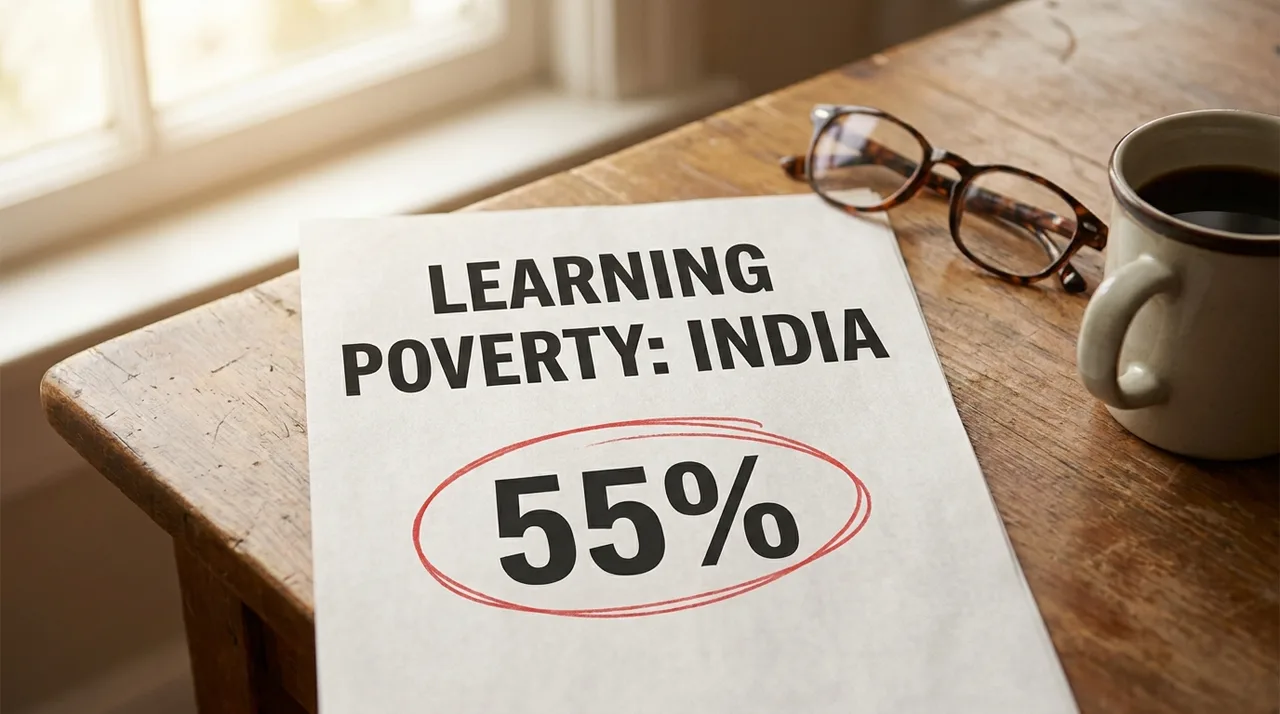
The numbers behind this mission are genuinely alarming, and they’re specific to India. The World Bank’s own “learning poverty” data — cited directly in the Ministry’s implementation guidelines — is stark. Not a global average. India’s own figure.
“Learning poverty” is a stark term for a simple thing: a child who’s been in school for years but still can’t get meaning from a page. That’s not a maths problem or a motivation problem — it’s usually a foundation problem, built in the first few years and rarely revisited once a child moves past the age where “just teach them to read” is on anyone’s to-do list.
The same guidelines put India’s figure inside a wider regional picture, drawing on UNESCO Institute for Statistics data. The gap between regions is enormous — and it’s exactly the gap NIPUN Bharat exists to close for India specifically, rather than leaving it to a global average nobody is accountable for.
Children not achieving minimum reading and maths proficiency
| Region | Share of children |
|---|---|
| Central and Southern Asia | 81% |
| Sub-Saharan Africa | 87% |
| Europe and Northern America | 7% |
Globally, of children who complete primary education, roughly one in two still lack basic reading skills.
There’s a second number worth knowing, and it’s the one I actually use in class. Reading researchers estimate a child needs to read at least 45 to 60 words a minute before the words stop eating up all their working memory — before there’s any mental room left over to think about what the sentence means. Below that speed, a child can decode every word correctly and still have no idea what they just read, because decoding used up the whole tank. That’s why NIPUN Bharat’s targets are partly about speed, not just accuracy — and it’s the single most common thing I have to explain to a worried parent.
Where do these targets actually come from?
They weren’t written by a single office overnight. The Guidelines for Implementation state that a dedicated drafting committee — with members from the Ministry of Education, NCERT, UNICEF, and the state governments of Gujarat, Haryana, and Uttar Pradesh — built them, with formal sign-off at Secretary level in the Department of School Education and Literacy.
Two things stand out about that process, worth knowing before you take any of this on faith. First, the Lakshya were built on NCERT’s own learning-outcomes research plus international reading studies — not invented targets, adapted ones. Second, the document itself says NCERT plans to run further Oral Reading Fluency studies for Indian languages specifically, and update the Lakshya as that research comes in. In other words, this framework is meant to be revised, not treated as final. It’s the government’s own honest position, and I think parents should know that rather than assume it’s carved in stone.
What should my child actually know at each age? The real government targets
This is the part every other explainer skips, and it’s the part that actually helps. Below are the Mission’s own Lakshya — targets — word for word, for Oral Language, Reading, and Writing, at each stage from Balvatika through Class III. I’ve added one line under each stage on what I actually watch for in class. Ages are ranges, not deadlines — a child who arrives a term late to any of these is not behind in any way that matters.
Balvatika
Best for ages 5–6The government’s word for pre-primary — the year before formal schooling starts.
Looks at books and attempts reading the story with the help of pictures
Begins to point out and recognize some familiar repeated words (sight words or words on containers/food wrappers)
Recognises letters and corresponding sounds
Reads simple words comprising of at least 2 to 3 alphabets.
Imitates act of writing during play. Begins to form recognizable letters.
Recognizes and writes his/her own first name
What I watch for: not fluent reading — nobody expects that yet. I want to see a child point at a real letter and offer its sound without a long pause, and recognise their own name on sight. That’s the whole Balvatika bar, and it’s a lower bar than most anxious parents assume.
Class I
Best for ages 6–7Participates during read aloud/story telling session in an active way and answers questions during and after story session; acts out familiar story with props and puppets
Uses sound symbol correspondence to write words with invented spellings.
Reads small sentences consisting of at least 4-5 simple words in an age appropriate unknown text.
Develops familiarity with matras in the words occurring in familiar contexts (story/poems/environment print etc.)
“Invented spellings” is the phrase that trips parents up most. If your six-year-old writes “kat” for “cat,” that’s not a mistake to correct hard — it’s exactly what this target wants. It means the sound-to-letter link is firing correctly, even before spelling convention has caught up. Correct it gently, over time, and don’t let it read as failure.
Class II
Best for ages 7–8Reads and narrates/re-tells the stories from children’s literature/textbook.
Makes new words from the letters of a given word
Reads age appropriate unknown text of 8-10 sentences with simple words with appropriate speed (approximately 45 to 60 words per minute correctly) comprehension, and clarity.
Writes short/simple sentences correctly to express herself.
That 45–60 wpm figure is the working-memory threshold I mentioned earlier, made concrete. If your Class II child is well under that number on an unfamiliar page, comprehension is very likely the real casualty, not effort or intelligence — and it’s fixable with the right kind of daily practice, not more homework volume.
Class III
Best for ages 8–9Finds information in familiar books/textbooks.
Reads at least 60 words per minute correctly and with comprehension depending on the language and with correct pronunciation from an age appropriate unknown text.
Reads and follows instructions given in the text
Can answer at least 3 out of 4 questions based on reading of an age appropriate unknown story/paragraph of 8-10 sentences.
Writes short messages for different purposes.
Writes grammatically correct sentences.
This is the national finish line — 60 words per minute, with real comprehension, on a passage the child has never seen before. Notice what it isn’t: it isn’t reading a memorised book fluently, and it isn’t reciting from pictures. Unfamiliar text is the whole point of the test, and it’s exactly the distinction I’ve written about before in the leveled-reader trap — a child who only performs well on familiar, predictable books hasn’t actually met this target yet, even if it looks like they have.
Common worries — is this normal?
None of this is in the government document — it’s what I actually tell parents in class when one of these comes up, because the same five questions arrive every term.
What are the 9 building blocks of foundational literacy?
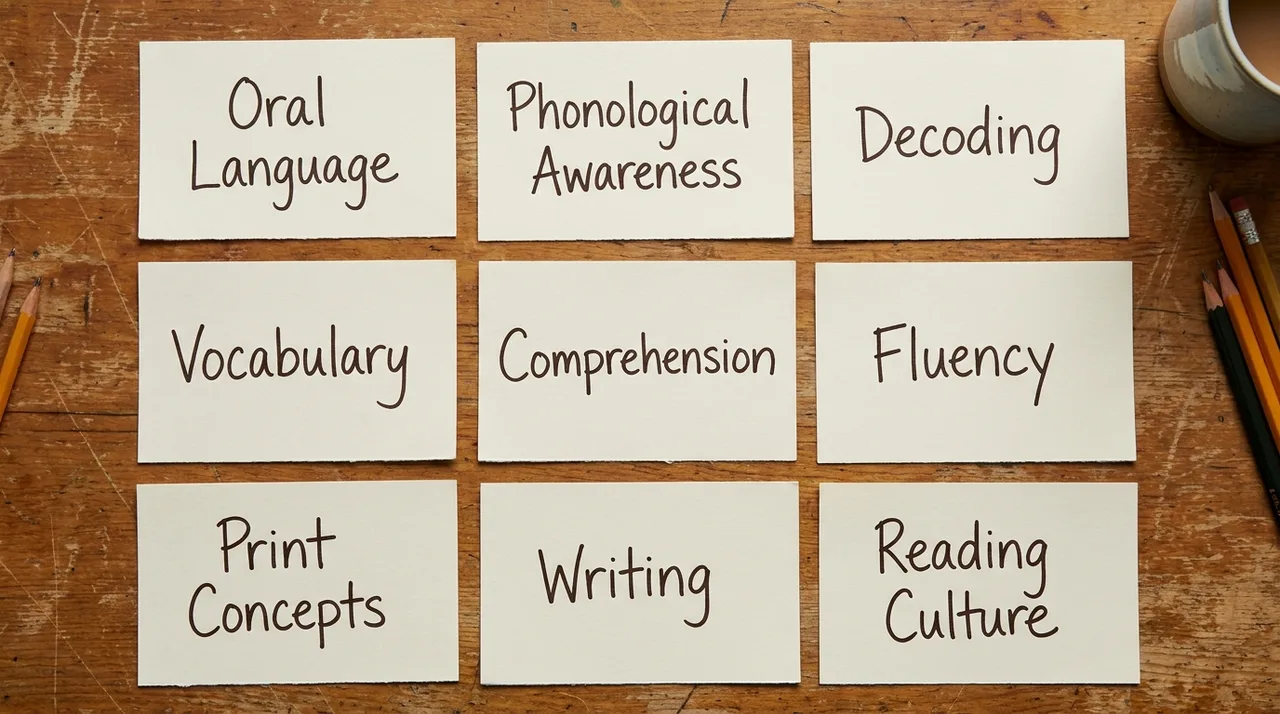
The Mission doesn’t leave “literacy” vague. Its own guidelines break it into nine specific components, and reading through them for the first time was one of those rare moments where a government document and my own classroom experience lined up almost exactly.
The experiences in oral language are important for developing skills of reading and writing.
Word awareness, rhyme awareness, and awareness of the sounds within words.
Print awareness, akshara/letter knowledge, and word recognition.
Oral vocabulary, reading/writing vocabulary, and morphological analysis of words.
Understanding texts, retrieving information from them, and interpreting them.
Accuracy, speed (automaticity), and expression (prosody) together — the combination that lets a child make meaning from text.
How books and print actually work, built through exposure to a print-rich environment.
Writing aksharas and words, as well as writing for self-expression.
The motivation to actually want to pick up a book — engagement with a wide variety of reading material.
Here’s the part I find reassuring as a trainer, not just as marketing copy: this is the same skill breakdown that a properly structured phonics programme like Jolly Phonics already targets — phonemic awareness, decoding, fluency, comprehension, all named directly. That overlap is worth sitting with for a moment, and it leads to a question parents ask me constantly.
Does NIPUN Bharat actually recommend phonics?
Not exclusively, and I want to be straightforward about that rather than stretch a government document to fit my own teaching method. The guidelines are explicit: several approaches have been used to build foundational literacy over the years — a phonics approach, a keyword approach, whole language — and each has real limitations on its own. NIPUN Bharat’s official position is a Balanced Approach, blending elements of all of them rather than backing one exclusively.
The document’s own definitions are worth quoting directly, since they clear up a genuine confusion:
How the Guidelines define each approach
| Approach | The government's own definition |
|---|---|
| Phonics approach | Children are taught by “introducing letters or aksharas first and gradually building a correlation with their sound.” |
| Whole language approach | Children are “immersed in print rich, literate environments,” learning through authentic children’s literature and modelled reading and writing. |
| Balanced Approach (official position) | Blends elements of both — teachers use “what is appropriate for their classroom” rather than one method exclusively. |
So where does that leave phonics specifically? Named, and clearly present — phonemic awareness sits right alongside comprehension as one of the two things the Balanced Approach says must be held together, not traded off against each other. It’s simply not the whole approach on its own, officially, and I’d rather tell you that plainly than imply a government endorsement that isn’t actually written down. What I can say from the classroom, as my own professional view rather than anything the Mission states: a taught, systematic sound sequence is what makes the “form” half of that balance reliable rather than accidental, which is why it’s the backbone of how I teach — inside a broader, more balanced week that includes exactly the read-aloud, shared-reading, and real-book time the guidelines also describe.
How can parents actually support these goals at home?
You don’t need a curriculum, and you don’t need to relabel bedtime as FLN (Foundational Literacy and Numeracy) practice. Five focused minutes a day, tied to the actual gap, moves these numbers faster than an hour of unfocused homework.
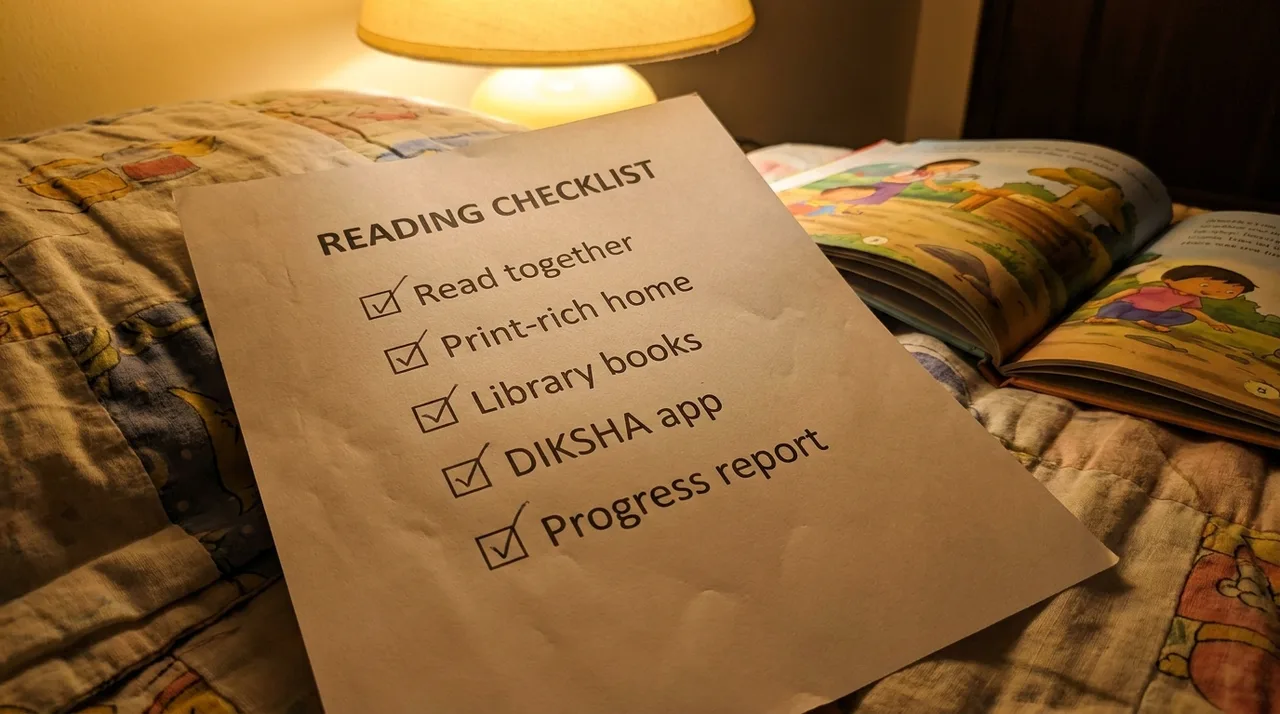
None of this is guesswork on my part, either — the Guidelines include the Mission’s own “Parent Activity Checklist” (page 42), and most of it is exactly this practical. Tick these off as you go — the checklist below saves your progress on this device.
If you only do one thing tonight, do this. It works at any age from Balvatika through Class III — just swap in whatever your child is currently reading.
One unfamiliar page — a cereal box, a menu, a page from tonight’s book they haven’t seen before.
Once, pointing at each word as you say it.
“What happened first?” — never “did you understand?”
Read books, sing rhymes, and narrate stories together, using voice and expression
Keep a print-rich home — read labels on packages, newspaper words, and currency together
Download DIKSHA on your phone and use it for guided e-content
Borrow story books or worksheets from the school library instead of buying everything
Ask for and discuss your child’s “tracking progress” report at parent meetings
The three fixes below are my own translation of that same checklist into what to actually do tonight.
Point at real letters on cereal boxes, signs, and book covers all day, and ask for the sound, not the name — “what does this one say?” not “what letter is this?” Two minutes, a dozen times a day, beats one sit-down drill.
Re-read the same short, unfamiliar-to-them passage once a day for a week, timing it loosely. Speed climbs fastest on text a child has practised recently but hasn’t memorised outright — which is also exactly what decodable books at the right stage are built for.
Let invented spelling stand uncorrected in the moment — write a shopping list together and let them “spell” a few words their own way. Fix spelling gently, later, in a completely separate sitting. Correcting live kills the confidence that’s doing the real work.
Short decodable passages built only from sounds a Balvatika or Class I child has already been taught — so the re-reading practice above has something to work on that isn't guesswork. Written and published by Monika Verma.
View in shopThe same government checklist has a second half aimed at your relationship with the school, not home practice. Small administrative habits — but the checklist treats them as seriously as the reading practice itself.
Enrol your child in the age-appropriate class from the start
Actually read the SMS/WhatsApp messages teachers send about home activities
Attend PTMs and ask specifically about your child’s progress report, not just general updates
Join the class WhatsApp group where teachers share digital content and updates
For the full daily routine I actually use with my own students — not just these three fixes — I’ve laid it out step by step in the free Phonics at Home guide.
Is NIPUN Bharat only for government schools? What about private and international families?
A common assumption, and a wrong one: NIPUN Bharat is not government-school-only. The Guidelines state its goals are “required to be achieved by all Govt., Govt. Aided and Private Schools” — private schools inside India are explicitly in scope, not exempt.
That inclusion is not a footnote. NEP 2020 goes further, stating that public and private schools (barring those centrally run) will be “assessed and accredited on the same criteria, benchmarks, and processes.” A private-school seat doesn’t place a family outside this framework.
As per UDISE 2019 data cited in the NIPUN Bharat Guidelines, nearly 50% of all school-going children in India — about 120 million students — are enrolled in the country’s 4.5 lakh privately managed schools. The Mission was never written for a minority of families.
What’s outside it is schools based outside India, or ones running a fully non-Indian curriculum — a different country, a different jurisdiction, no NIPUN Bharat oversight. For the many families I teach who live abroad, that’s the honest boundary: this specific mission doesn’t reach you administratively. But the reading science behind the targets does — a 60-words-per-minute comprehension benchmark reflects how working memory functions in any child, in any schooling system, in any country, which is why the checklist above is still worth using as a free checkpoint, not a compliance requirement.
How do I know if my child is on track?
Everything above is a self-check, not a diagnosis — a real one needs a person actually listening to your child read and talk, not a checklist against a screen. Here are your two honest options.
Monika listens to your child read, live, and tells you exactly where things stand against these targets. No card, no obligation.
Book the free Demo ClassWalks through what's typically expected at each age in plain language — a genuine self-check, free, no booking needed.
Points at a real letter and gives its sound without a long pause, and recognises their own name on sight. Fluent reading isn’t expected yet.
Writes with invented spellings (“kat” for “cat”) and reads short 4–5 word sentences in unfamiliar text.
Reads unfamiliar text at roughly 45–60 words a minute with real comprehension, not just accuracy.
Reads at least 60 words a minute, understands what they read, and can answer 3 of 4 questions about it — the national finish line.
Frequently asked questions
- NIPUN Bharat Mission — Guidelines for Implementation. Department of School Education & Literacy, Ministry of Education, Government of India (retrieved July 2026)
- National Curriculum Framework for Foundational Stage 2022. NCERT (retrieved July 2026)
- National Education Policy 2020. Ministry of Education, Government of India (retrieved July 2026)
- World Bank learning-poverty estimate for India, cited in NIPUN Bharat Mission: Guidelines for Implementation, Ministry of Education, Government of India (retrieved July 2026)
Every child develops at their own pace, and these are typical government targets, not deadlines for your specific child — see our learning-outcomes note. Want a real check on where your child stands? The free 20-minute Demo Class is built for exactly that.

The ‘I Spy’ Sound Game: Teaching First Sounds at Home (Without Teaching It Wrong)
10 min read
The Importance of Nursery Rhymes: How Rhyme and Rhythm Feed Reading
10 min read
Listening Games for Kids: Building the Skills That Come Before Reading
10 min read
What Are Decodable Books? Why Beginners Need Books Without Tricky Words
9 min readGet one useful tip a week
Written by Monika. No spam, no daily emails — just what's worth your five minutes.