Is, Am or Are? How to Teach Your Child Which One to Use
Mixing up is, am and are is one of the most common slips young children make. When to use each, the shortcut that causes "I is", a Hindi bridge with its traps, and a free Class 1 and 2 worksheet.
- "I" always takes "am"; he, she and it take "is"; you, we and they take "are".
- "Is for one, are for many" is the shortcut that causes "I is" and "you is".
- Hindi's hoon, hai and hain map onto am, is and are, with one catch: respectful hain (Papa hain) is still "Papa is".
- Curricula expect this around ages 6 to 7 (Class 1-2); "we were" comes a little later.
“I is ready!” “They is my friends.” Mixing up is, am and are is one of the most common slips young children make in English. Choosing the right one comes down to one question: who is the sentence about? Below you’ll find the rule, the shortcut that causes most mistakes, a Hindi bridge that helps many Indian children, and a free Class 1–2 worksheet. It’s one piece of the bigger picture in our guide to teaching English grammar at home.

The short answer
All three are forms of one verb, “be”. Which one you use depends only on the subject, the person or thing the sentence is about. “I” always takes “am”. “He”, “she”, “it” and one person or thing take “is”. “You”, “we”, “they” and more than one thing take “are”. The past works the same way with two forms: “was” and “were”. Practise with real sentences about your own family, out loud; it’s the easiest practice to fit into a day.
How do is, am and are actually work?
“Be” is the oddest verb in English. Most verbs barely change: I run, you run, they run. “Be” changes completely depending on who it’s about. As a main verb, it doesn’t describe an action. It links the subject to a description: “The mango is ripe.” “We are late.”
That’s why it takes time. Roger Brown’s classic 1973 study tracked the grammar pieces children learn first. Even children learning English from birth mastered the short forms “he’s” and “they’re” among the very last. For a child learning English alongside Hindi, still sorting this out at six or seven is common.
Why isn’t “is for one, are for many” enough?
This is the rule most children are taught first, and it causes most of the mistakes. It works for things: one book is, two books are. But it breaks the moment people come in. “I” is one person, yet it never takes “is”. “You” can be one person, yet it always takes “are”. A child applying the shortcut faithfully will say “I is” and “you is”. They’re following the rule they were given.
- “Is” is for one thing
- “Are” is for many things
- “I” is one, so “I is”
- “You” is one person, so “you is”
- “Is” is for he, she, it, or one person or thing
- “Are” is for you, we, they, or many things
- “I” has its own word: always “am”
- “You” always takes “are”, even for one person
How should you teach it at home?
Teach it by who, not by how many. Start with “I am”, because it’s the one fixed pair with no exceptions. Then add “he is, she is”. Leave “you are” and “they are” for last, once the first two feel automatic. Keep it spoken and personal: “I am tall. Dadi is funny. You are my son. They are our neighbours.” Children usually remember sentences about people they love better than sentences about a boy called Tom.
When your child slips, repeat it the right way and move on. “I is hungry!” “You are hungry? Me too.” Hearing the right form many times, in real talk, matters more than any single correction.
Free Is, Am, Are Worksheet for Class 1 and Class 2
A who-takes-what table with the Hindi bridge, 12 fill-in-the-blank sentences, a circle-the-word section, a family writing task and an answer key. Free, printable A4.

Is there a Hindi shortcut for is, am and are?
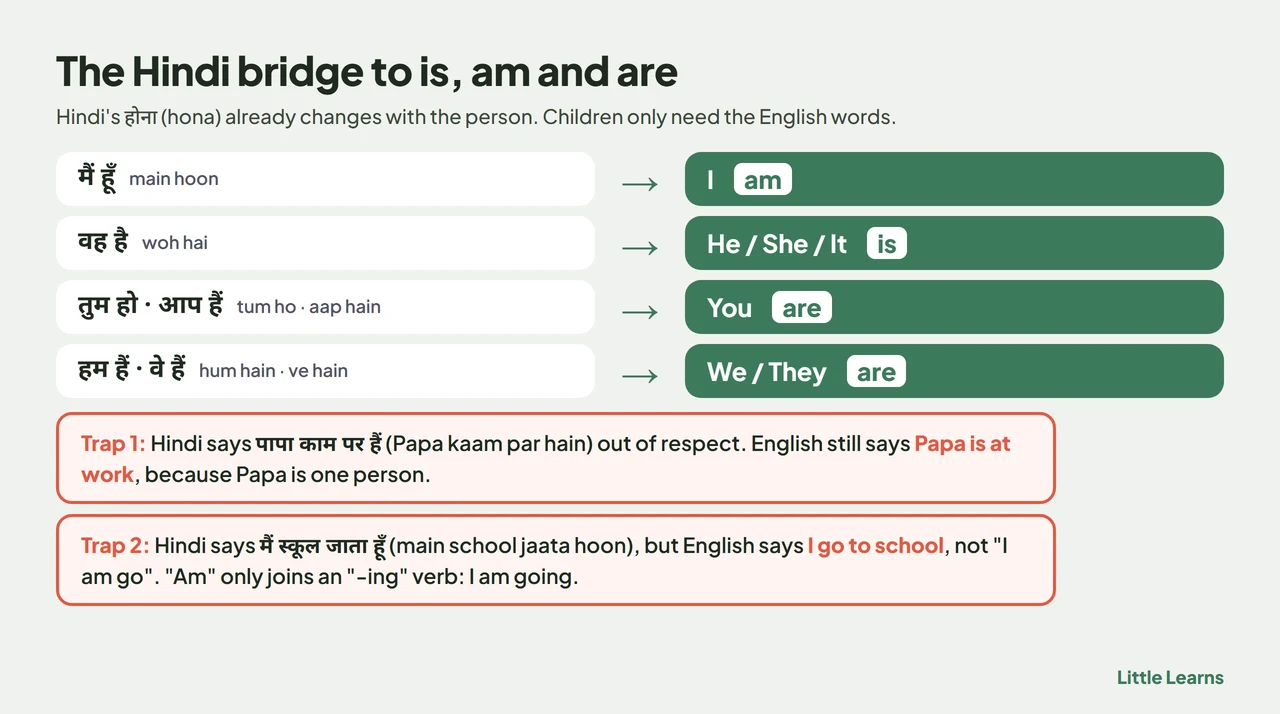
Yes. Hindi’s verb “to be”, hona (होना), also changes with the subject, just as English “be” does. Main hoon is “I am” and woh hai is “he is” or “she is”. Tum ho or aap hain is “you are”, and hum hain or ve hain is “we are” or “they are”. So Hindi-speaking children already understand the idea. They only need the matching English words:
- Main hoon (मैं हूँ) → “I am”
- Woh hai (वह है) → “He is” / “She is” / “It is”
- Tū hai (तू है), tum ho (तुम हो), aap hain (आप हैं) → “You are”
- Hum hain (हम हैं), ve hain (वे हैं) → “We are” / “They are”
- tha (था), thi (थी) → “was” · the (थे), theen (थीं) → “were”
Two catches to point out. First, Hindi “you” can take hai, ho or hain, depending on closeness and respect. English “you” always takes “are”, whoever you’re speaking to.
Second, and more important: Hindi uses hain for one respected person, as in Papa kaam par hain. English doesn’t. It’s still “Papa is at work” and “Dadi is in the kitchen”. Point this out early, or the Hindi bridge will lead your child to “Papa are”. The past works the same way: respectful Papa the is still “Papa was“.
Third, and the most common slip of all: Hindi puts hoon or hai on almost every present-tense verb (मैं स्कूल जाता हूँ, main school jaata hoon). So children say “I am go to school” or “She is like mangoes”. Everyday English verbs don’t need is, am or are: it’s “I go to school” and “She likes mangoes”. “Am” only joins a verb in the “-ing” form: “I am going”. Our guide to teaching tenses shows the two present tenses side by side.
Which other slips should you listen for?
Listen for “is” dropped from “-ing” sentences: “He going to school” (school way: “He is going to school”). Say the full sentence back and carry on. Also listen for “We was” (school way: “We were“). A few others, like “Where you are going?”, are Indian English patterns covered in our guide to common grammar mistakes Indian kids make. For past and future more broadly, see how to teach tenses to kids.
is, am और are “be” के तीन रूप हैं। सही शब्द इस बात से तय होता है कि वाक्य किसके बारे में है: “I” के साथ am, “he, she, it” के साथ is, और “you, we, they” के साथ are। हिंदी में भी क्रिया कर्ता के साथ बदलती है: मैं हूँ, वह है, तुम हो, आप हैं, हम हैं। तीन बातें ध्यान रखें: अंग्रेज़ी में “you” के साथ हमेशा are आता है, और आदर वाला “पापा हैं” अंग्रेज़ी में “Papa is” ही होता है। और हिंदी की तरह हर क्रिया के साथ am/is न लगाएँ: “I go to school” सही है, “I am go” नहीं। घर के लोगों के बारे में छोटे वाक्य बोलकर अभ्यास कराएँ।
“When I type main hoon next to ‘I am’ on screen in class, I can see it click. Children realise they already do this in Hindi. They only need the English labels.” Monika Verma, Lead Trainer, Little Learns
At what age should children get is, am and are right?
NCERT’s learning outcomes, which CBSE adopted for Classes I–VIII, don’t list is, am and are as grammar items. The closest Class II goals are everyday phrases like “How are you?” and “I’m fine, thank you” (2.E.LO6), using “he”, “she” and “it” (2.E.LO10), and writing simple, short sentences (2.E.LO12). “Subject-verb agreement” is only named as a topic in Class IX (9.E.LO18). An open skill-progression framework, the Marble skill taxonomy, places it at ages 6 to 7. England’s national curriculum expects “we were” rather than “we was” in Year 4, around age 8 to 9.
In practice: expect “I am, he is, they are” in speech by about Class 2. “Was” and “were”, and tricky cases like “everyone is”, often settle by Class 3 or 4.
Choose “is” or “are” to match a singular or plural subject in their own sentences
Spot and fix a sentence like “The children plays” or “The children is playing”
Choose the right verb for a singular or plural subject in a gap-fill
Before you go: quick answers
- Brown, R. (1973). A First Language: The Early Stages. Harvard University Press (retrieved September 2026)
- NCERT Learning Outcomes (Elementary 2017; Secondary 2019), coded edition by DERT Meghalaya, 2021: English, Classes I–X (retrieved September 2026)
- Department for Education (England). English Appendix 2: Vocabulary, grammar and punctuation (Year 4: “we were” instead of “we was”) (retrieved September 2026)
- CBSE. Circular Acad-05/2019: Learning Outcomes for Classes I–VIII (retrieved September 2026)
- Marble Skill Taxonomy (v1), Generative Spark, Inc. Subject-verb agreement (ages 6–7). Content CC BY-SA 4.0; database ODbL 1.0 (retrieved September 2026)
Every child develops at their own pace — see our learning-outcomes note. These age ranges are typical, and a child who needs longer is still on track.
Does Speaking Hindi at Home Affect Your Child’s English Grammar?
12 min read
Why Does My Child Skip ‘A’, ‘An’ and ‘The’? How to Teach English Articles to Hindi-Speaking Kids
10 min read
How to Teach English Grammar to Kids: Hear It, Say It, Build It, Name It
18 min read
How to Teach Tenses to Kids: Talk First, Tense Chart Last
10 min readExplore the Journal
Teaching Your Child English Grammar
The grammar-at-home series: how children really learn grammar, and what to do about the everyday mistakes Indian children make. 6 articlesTeaching Your Child to Read
The phonics-first pillar series: how reading actually happens, and how to support it at home. 23 articlesGet one useful tip a week
Written by Monika. No spam, no daily emails — just what's worth your five minutes.