Does Speaking Hindi at Home Affect Your Child’s English Grammar?
Does Hindi at home hurt your child's English grammar? What research shows about bilingualism, mixing languages and what actually helps.
You speak Hindi at home. School teaches in English. Then your child says “I am having two brothers” or mixes both languages in one sentence. Then the question arrives: is the home language holding your bilingual child’s English back? Here is what the research says about bilingualism and grammar, what it does not say, and what to do at home. It sits within our parent’s guide to teaching English grammar.
The short answer
Not by itself. Hindi (or another home language) at home does not harm a child’s English grammar, but a child who hears less English tends to know less English, and that part you can change. Bilingual children are also no more likely to have language difficulties. In one US study of Spanish-English children (Hoff and Ribot, 2017), English vocabulary lagged by six months to a year between ages 2.5 and 5, with shorter lags for children who heard more English. The fix is to add good English while keeping Hindi. Read aloud daily, ask open questions in English, and repeat slips back correctly without a lesson. Most of the research below followed toddlers and preschoolers in the US, not Indian school-age children.
Does speaking Hindi at home slow down English grammar?
Mostly it is a question of exposure. In a 2012 study of toddlers, Erika Hoff and colleagues (Journal of Child Language) found that bilingual children looked behind children who heard one language, in vocabulary and grammar, when each language was measured on its own. Within the bilingual group, every measure tracked how much of that language the child heard. So the gap points to exposure, not confusion.
The 2017 Journal of Pediatrics study by Hoff and Ribot followed Spanish-English bilingual children from age 2.5 to 5. They lagged children who heard only English by six months to a year in English vocabulary, and the lag was shorter where children heard more English. In a 2017 study of 858 Spanish-speaking preschoolers (Goodrich and Lonigan), sound and print skills carried across languages, but oral language did not. These children lived in the US, so treat this as a strong clue, not a verdict.
India’s own documents lean the same way. NCERT’s elementary English syllabus says that simultaneous exposure to several languages does not, “as many people tend to believe”, “confuse” children, and that using children’s own languages “may turn out to be most productive for teaching English”. The National Education Policy 2020 recommends, wherever possible, home-language instruction until at least Grade 5, which shows the same respect for the home language.
Is mixing Hindi and English in one sentence a sign of confusion?
No. Mixing languages, called code-switching, is a normal part of growing up bilingual. In their guide for parents, Krista Byers-Heinlein and Casey Lew-Williams note that children often mix when they do not yet have the word in one language, and that this is developmentally normal. They also note that bilingual children are not more likely than monolingual children to have language difficulties. A similar share of bilingual and monolingual children do have a genuine language disorder, so real concerns still deserve attention. “Mama, mujhe ek glass of water chahiye” uses both languages smoothly.
Why does my child translate from Hindi word for word?
Because the child is using Hindi sentence structure to build English, which is a smart move, not a sign that two languages are fighting. These are the carry-overs Monika hears most in her classes, and each has a simple school form.
- “He is a very smart girl” becomes “She is a very smart girl” (Hindi vah is one word for he and she).
- “I am knowing the answer” becomes “I know the answer” (Hindi says main jaanta hoon, a simple present).
- “I am waiting here from two hours” becomes “for two hours” (Hindi se becomes “from”).
- “She went to market to buy pencil” becomes “She went to the market to buy a pencil” (Hindi does not use articles the way English needs them).
Our guide to the mistakes Indian kids make sorts more of these into typical and worth-watching.
Should we switch to speaking only English at home?
Usually it is not needed. If English is not your strongest language, an English-only rule can mean your child hears thinner English at home than school and books already give. Speech and language therapists agree. In its guidance to therapists, the Royal College of Speech and Language Therapists says parents “should never be advised to abandon home language in favour of the majority language”. Talk in the language you are most comfortable in and add English through books and conversation.
- “Speak only English at home so school English improves”
- “Two languages will confuse grammar”
- “A strong home language helps English grammar automatically”
- The amount and quality of English your child hears and reads is what counts, not removing Hindi
- Mixing is normal, and bilingual children are not more likely to have language difficulties
- Sound and print skills carried across languages in one study, but oral language did not, so English still needs English input
“In my classes I see mixing languages as a child using everything they know, not a sign of confusion. Please do not force an English-only rule at home. Children need rich, fluent, emotionally deep conversation, and that happens most naturally in your own language. If you speak only English before you are comfortable with it, the vocabulary becomes limited and you lose meaningful family connection.” Monika Verma, Lead Trainer, Little Learns
Our students speak Hindi, Tamil, Marathi, Gujarati, Malayalam and Telugu at home. They join our Zoom groups of up to six from India, the UK, the US, the UAE, Oman, Singapore, Germany, Japan, Korea, the Czech Republic and Africa.
Three habits that help a bilingual child’s English grammar
First, read aloud every day, in either language. Stories give a child many correct sentences they would rarely hear in conversation. Second, keep talk going both ways. Ask open questions in English (“What happened at school today?”) and repeat slips back correctly, as in the examples above. Third, keep the home language rich, so your child has a full language to think in and to be proud of. If your own English feels shaky, a page your child reads aloud to you, an audiobook, or one picture book a night all count. Our guides to a, an and the and is, am and are cover specific patterns.
We found no study testing these habits on Indian children. They reflect wider bilingual research, speech-therapy guidance and what we see in our classes.
Books that help, in our shop and on Amazon.in. A library book or a grandparent reading aloud does the same job for free.

Introduces reading Hindi words and short passages one matra at a time, built from Monika’s teaching. For families who speak Hindi at home but do not know where to start with reading it.
View in shop
A Hindi grammar workbook with illustrated exercises that increase gradually in difficulty. For families who want the home language to keep growing alongside English.
View in shopA classic on why and how to read aloud to children, which is the habit this guide leans on most. The Kindle edition costs far less than the paperback.
View on Amazon.inAs an Amazon Associate, Little Learns earns from qualifying purchases. Links marked Amazon.in are affiliate links; the price to you is the same.
When is it worth asking a specialist?
Look closer when your child struggles to be understood in every language they speak. English grammar that lags behind what school expects is not, on its own, a warning sign. Bilingualism does not cause a language disorder. The American Speech-Language-Hearing Association says that being multilingual is not a communication disorder, and that signs of a real difficulty show up across all of a child’s languages, though symptoms usually differ from one language to another. Start with the class teacher, then a paediatrician or speech-language therapist.
This page is not a medical or diagnostic assessment. If you are worried about your child’s language overall, talk to your child’s teacher first, then a paediatrician or speech-language therapist.
घर पर हिंदी बोलने से बच्चे के अंग्रेज़ी व्याकरण को अपने-आप नुकसान नहीं होता। असली फ़र्क इससे पड़ता है कि बच्चा कितनी अच्छी अंग्रेज़ी सुनता, पढ़ता और बोलता है। हिंदी और अंग्रेज़ी मिलाकर बोलना सामान्य है। घर पर हिंदी बोलते रहें, रोज़ कहानी पढ़कर सुनाएँ, और ग़लती पर टोकने के बजाय सही वाक्य दोहरा दें।
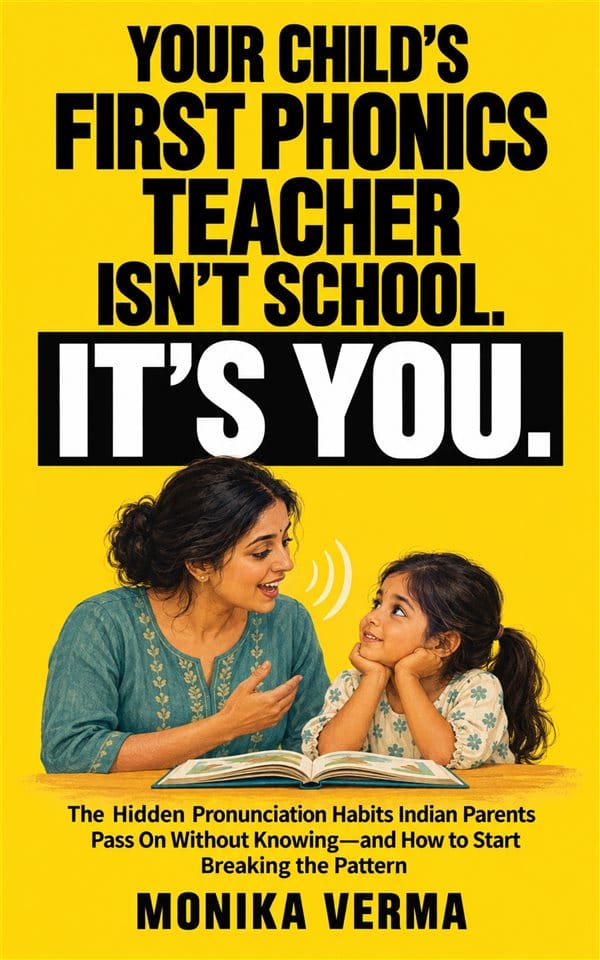
In a bilingual home, the sounds a child hears from you shape how they learn English. Monika’s short guide covers the pronunciation habits Indian parents pass on without knowing, and how to change them.
View on AmazonAs an Amazon Associate, Little Learns earns from qualifying purchases. Links marked Amazon.in are affiliate links; the price to you is the same.
Bilingual children and English grammar: quick answers
- Hoff, E., Core, C., Place, S., Rumiche, R., Senor, M., & Parra, M. (2012). Dual language exposure and early bilingual development. Journal of Child Language, 39(1), 1-27 (retrieved 2026-09-30)
- Hoff, E., & Ribot, K. M. (2017). Language growth in English monolingual and Spanish-English bilingual children from 2.5 to 5 years. The Journal of Pediatrics, 190, 241-245 (retrieved 2026-09-30)
- Byers-Heinlein, K., & Lew-Williams, C. (2013). Bilingualism in the early years: what the science says. Learning Landscapes (retrieved 2026-09-30)
- Goodrich, J. M., & Lonigan, C. J. (2017). Language-independent and language-specific aspects of early literacy. Journal of Educational Psychology (retrieved 2026-09-30)
- Royal College of Speech and Language Therapists. The role of the speech and language therapist with bilingual children (retrieved 2026-09-30)
- American Speech-Language-Hearing Association. Bilingual service delivery (retrieved 2026-09-30)
- NCERT. Syllabus for Classes at the Elementary Level: English (Classes I-VIII) (retrieved 2026-09-30)
- Press Information Bureau (2022). Education in mother tongue, on NEP 2020 para 4.11 (retrieved 2026-09-30)
Every family’s situation is different; our learning-outcomes note explains what to expect. Nothing on this page is medical advice or a diagnosis.

Why Does My Child Skip ‘A’, ‘An’ and ‘The’? How to Teach English Articles to Hindi-Speaking Kids
10 min read
How to Teach English Grammar to Kids: Hear It, Say It, Build It, Name It
18 min read
How to Teach Tenses to Kids: Talk First, Tense Chart Last
10 min read
Is, Am or Are? How to Teach Your Child Which One to Use
9 min readExplore the Journal
Teaching Your Child English Grammar
The grammar-at-home series: how children really learn grammar, and what to do about the everyday mistakes Indian children make. 6 articlesTeaching Your Child to Read
The phonics-first pillar series: how reading actually happens, and how to support it at home. 23 articlesGet one useful tip a week
Written by Monika. No spam, no daily emails — just what's worth your five minutes.