Why Does My Child Skip ‘A’, ‘An’ and ‘The’? How to Teach English Articles to Hindi-Speaking Kids
Hindi has no "the", so kids drop a, an and the. What is normal, a two-question test that helps, and a free printable card.
- Hindi has no "the" and nothing exactly like "a", so children often drop or muddle articles.
- Ask two questions: do we both know which one (the), or is it one of many (a or an)?
- Choose a or an by the next sound, not the letter: an hour, a university.
- A free printable card has twelve practice sentences with answers.
“I saw dog.” “She is doctor.” “Pass me salt.” If your child leaves out a, an and the, or scatters them in the wrong places, it is not carelessness. It is common when the home language has no articles. This guide shows why Hindi makes it hard and how to teach articles to kids with a two-question test. It is part of our parent’s guide to teaching English grammar.

The short answer
Dropping or muddling articles is normal for children whose home language, such as Hindi, has none, and it often takes a long stretch of listening and reading to settle. It is worth a closer look only if articles are missing in writing after long, steady practice, or if language is hard in every language your child speaks. Start with two questions your child can ask about any noun: do we both know which one? (then “the”) and if not, is it one of many, and singular? (then “a” or “an”). If “is”, “am” and “are” are the bigger muddle, see when to use is, am and are; for the wider picture, see the grammar mistakes Indian kids make.
Is English mostly a school language for your child, with Hindi or another language at home? That alone often explains much of this.
Is the pattern the same every time (“I saw dog”, “She is doctor”)? A steady pattern points to a borrowed rule, not a hearing problem.
Why are a, an and the so hard for Hindi speakers?
Hindi has no “the” and nothing that works exactly like “a”. It does have ek, meaning “one”, so a child who wants “a dog” often says “one dog”. Articles are the small words a, an and the. English asks for one of them before almost every singular noun, and Hindi gives your child nothing to copy from.
Studies of learners with other first languages point the same way. In a 2024 study of 660 essays by adult learners, those whose first language has no articles were less accurate with articles than learners whose first language has them (Derkach and Alexopoulou). They spoke Chinese and Russian, not Hindi. In a 2008 study of 17 young learners (Zdorenko and Paradis), none of them Hindi speakers, children often used “the” where “a” was needed. And in 2005, Devyani Sharma found that speakers of Indian English follow a consistent pattern with articles, tied to whether information is new or already shared. So these habits are not random slips. The test below teaches the standard school pattern.
NCERT’s elementary English syllabus lists articles among the primary-years grammar items, to be discovered through what children hear and read. As of September 2026 we have not found a study comparing reading with drills for articles, so what follows is good classroom practice, not a proven programme.
Is this typical, or worth a closer look?
Most article patterns in children who speak Hindi are typical. Only a complete absence of articles in writing, after steady practice, is worth raising with the teacher.
| Article patterns: typical vs. worth a closer look | ||
|---|---|---|
| Leaving out “a” before a singular noun: “She went to market to buy pencil”, “She is doctor” (school way: “She went to the market to buy a pencil”, “She is a doctor”) | Typical | Hindi does not need the word, so there is nothing to copy from. Add “a” gently when you repeat the sentence. |
| Using “one” for “a”: “I saw one dog on the road” (school way: “I saw a dog on the road”) | Typical | <em>Ek</em> means “one” and can also stand in for “a”. Keep “one” for counting. |
| Leaving out “the” for something you both know: “Pass me salt”, “I went to market” (school way: “Pass me the salt”, “I went to the market”) | Typical | A very common pattern that can take a long time to settle. It needs patience. |
| Using “the” for things in general: “I like the dogs”, “The milk is good for you” (school way: “I like dogs”, “Milk is good for you”) | Typical | Often a sign your child has noticed “the” and is trying it out. |
| “A” before a vowel sound: “a apple”, “a egg” (school way: “an apple”, “an egg”) | Typical | Fixed by saying the next word aloud (see below). |
| No articles at all in writing, despite steady practice over a year or more | Worth a look | There is no fixed age for this, but it is a good prompt to ask your child’s teacher. Often it is simply exposure, and the teacher can tell you. |
Teaching articles at home: the two-question test
Teach articles with two questions and three bonus rules, and let real sentences do the rest.
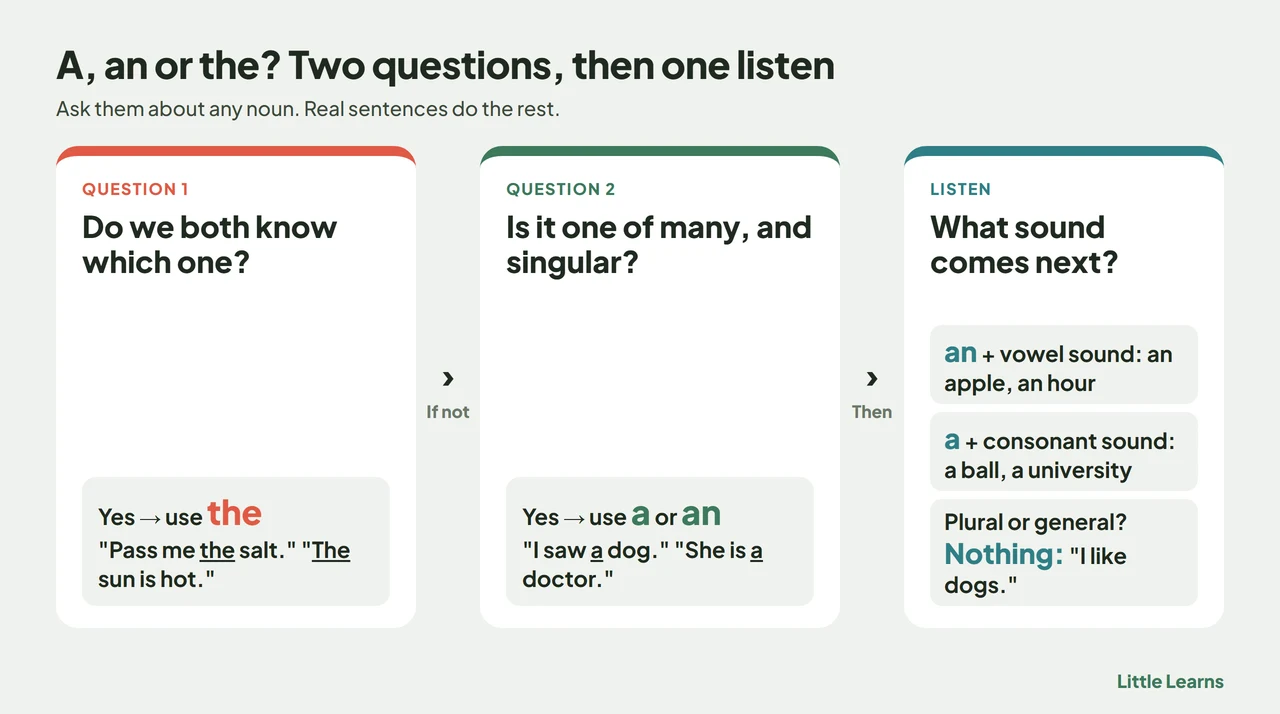
- Question one: do we both know which one? If yes, use “the”. “Pass me the salt” (the one on the table), “We went to the market” (the one we always go to), “The sun is hot” (there is only one).
- Question two: if not, is it one of many, and singular? Then use “a” or “an”. “I saw a dog” (some dog, not one we know), “She is a doctor” (one of many doctors).
- Bonus rule: first mention, then second mention. The first mention is usually “a”; the second is “the”. “I saw a dog. The dog was big.” Children often find this the most useful rule.
- Bonus rule: nothing at all. If it is plural or uncountable and you mean it in general, use no article. “I like dogs.” “Milk is good for you.”
- Bonus rule: some fixed phrases take no article. “Go to school”, “at home”, “by bus”. Others keep “the”, like “in the morning”. Learn them as whole chunks.
How do you choose between a and an?
Say the next word aloud and listen to its first sound, not its first letter. A vowel sound takes “an”: an apple, an hour (the “h” is silent). A consonant sound takes “a”: a ball, a university (it starts with a “yoo” sound). Ask “what do I hear first?”
Then make it a game. On a walk, say “Look at… bird!”, pause, and let your child choose “a bird” (any bird) or “the bird” (the one you both see). At bedtime, ask them to spot one “the” and one “a” in the story. Try two now: I saw ___ elephant at ___ zoo (an, the). ___ milk is good for you (no article). If your child moves between Hindi and English all day, you may also like our answer on how bilingualism affects English grammar.
For practice beyond the card, the first book is in our shop and the other two are on Amazon.in.

A grammar book-cum-workbook with 500-plus exercises and answers, for practising the basics once your child can already say them. Check the contents for the articles exercises.
View in shopA compact 32-page practice book, useful as a second set of examples.
View on Amazon.inA read-aloud that suits the bedtime game of spotting “the” and “a”. Its first line, “A mouse took a stroll through the deep dark wood”, has two “a”s and a “the”.
View on Amazon.inAs an Amazon Associate, Little Learns earns from qualifying purchases. Links marked Amazon.in are affiliate links; the price to you is the same.
A, an, the: two-question test card
A one-page printable with the flowchart and twelve practice sentences (answers on the back). Stick it on the fridge and use it for five minutes a week.
When should you ask a professional?
Dropped articles alone are not a reason to see a specialist. The American Speech-Language-Hearing Association says being multilingual is not a communication disorder, and that signs of a real difficulty show up across all of a child’s languages. Start with your child’s class teacher, then a paediatrician or speech-language therapist if a child struggles to be understood in every language they speak.
This page is not a medical or diagnostic assessment. If you are worried about your child’s language overall, talk to your child’s teacher first, then a paediatrician or speech-language therapist.
हिंदी में “a” और “the” जैसे शब्द नहीं होते, इसलिए बच्चे इन्हें अक्सर छोड़ देते हैं। यह सामान्य है और सुधरने में समय लगता है। दो सवाल पूछें: “क्या हम दोनों जानते हैं कि कौन-सी चीज़?” तो “the”। नहीं, और वह कई में से एक है, तो “a” या “an”, और अगला शब्द जिस आवाज़ से शुरू हो, उसी से चुनें।
“When a child says ‘She went to market to buy pencil’, I do not hear carelessness. Hindi does not use articles the way English needs them, so the child is carrying a natural pattern across. I hear this kind of carry-over often in my classes, along with mixing up he and she, ‘I am knowing’ and ‘from two hours’ for ‘for two hours’.” Monika Verma, Lead Trainer, Little Learns
Articles: questions parents ask
- Sharma, D. (2005). Language transfer and discourse universals in Indian English article use. Studies in Second Language Acquisition, 27(4), 535-566 (retrieved 2026-09-30)
- Derkach, K., & Alexopoulou, T. (2024). Definite and indefinite article accuracy in learner English: a multifactorial analysis. Studies in Second Language Acquisition, 46(3), 710-740 (retrieved 2026-09-30)
- Zdorenko, T., & Paradis, J. (2008). The acquisition of articles in child second language English: fluctuation, transfer or both? Second Language Research, 24(2), 227-250 (retrieved 2026-09-30)
- American Speech-Language-Hearing Association. Bilingual service delivery (retrieved 2026-09-30)
- NCERT. Syllabus for Classes at the Elementary Level: English (Classes I-VIII) (retrieved 2026-09-30)
- NCERT Learning Outcomes (Elementary 2017; Secondary 2019), coded edition by DERT Meghalaya, 2021: English, Classes I-X (retrieved 2026-09-30)
Results vary from child to child; details are in our learning-outcomes note. This is not a medical or diagnostic assessment. If you are worried, start with your child’s teacher.


Explore the Journal
Teaching Your Child English Grammar
The grammar-at-home series: how children really learn grammar, and what to do about the everyday mistakes Indian children make. 6 articlesTeaching Your Child to Read
The phonics-first pillar series: how reading actually happens, and how to support it at home. 23 articlesGet one useful tip a week
Written by Monika. No spam, no daily emails — just what's worth your five minutes.