How to Teach Tenses to Kids: Talk First, Tense Chart Last
Tenses often arrive as a twelve-box chart to memorise. Here is a six-week, talk-first way to teach tenses at home, ending with a small tenses chart and free printable sorting cards.
- Teach time before grammar: yesterday, today and tomorrow in everyday talk.
- "Goed" is a sign of learning the -ed rule, and it is rare.
- Bring out a small six-box tenses chart last, filled with your child's own sentences.
- The full 12-tense table can wait until about age 10.
Tenses often arrive as a twelve-box chart to memorise, long before a child can use the forms in their own speech. There’s a better order for teaching tenses to kids. Talk about time first, and notice the patterns in stories second. Bring out a small tenses chart last, as a summary of what your child can already say. Here’s a six-week plan you can run at home. For the wider picture, see our parent’s guide to English grammar.

The short answer
A tense tells you when something happens: before now, now, or later. Children understand time long before they understand grammar, so start there. Talk every day about yesterday, today and tomorrow, and let your child hear the verbs change. Collect irregular verbs from stories. Only then bring out a chart, and fill it with your child’s own sentences. One habit helps most: when a tense slips mid-story, say the sentence back correctly and let the story carry on.
You need nothing. A family photo album or a wall calendar helps, but isn’t required.
Best moment: dinner, a car ride, or bedtime, when your child is already chatting.
Ask one “yesterday” question and one “tomorrow” question, and just listen.
If your child mixes tenses, say their sentence back correctly and keep going.
Watch for irregular verbs like went, saw and ate. They’re the ones to collect.
What’s the six-week plan for teaching tenses?
- Week 1: Yesterday, today, tomorrow
At dinner, ask one question about each. “What did you eat yesterday? What are you doing now? What will we do tomorrow?” Just let your child hear the three shapes of time.
- Week 2: Retell a real day
Look at photos from an outing and ask your child to tell you what happened. Ask follow-up questions that need the past tense: “Where did you go next? What did you see?”
- Week 3: Hunt irregular verbs
After the bedtime story, look back for two or three past-tense verbs. Is each one an “-ed” word, or a surprise like “ran” or “caught”? Start a list on the fridge.
- Week 4: Plans and predictions
Talk about the weekend, a birthday, or what a story character will do next. Add “will” and “going to” alongside the past and present.
- Week 5: Sort sentences
Write ten of your child’s own sentences on slips, or use the cards in our printable below, and sort them into yesterday, every day, now and tomorrow. Mixed-up ones become puzzles to solve.
- Week 6: Now the chart
Bring out a simple chart and fill it together with sentences your child has actually said. By now the chart is a summary of what they know.
Where does the tenses chart come in?
At the end, and smaller than you’d expect. For six- to nine-year-olds, a six-box chart is plenty. Past, present and future go across the top. Down the side go the simple form and the “-ing” form. Irregular verbs like go and went get their own collection list underneath. That isn’t every tense in English; it’s the handful children actually use. Here’s what it looks like:
| Past (yesterday) | Present (every day / right now) | Future (tomorrow) | |
|---|---|---|---|
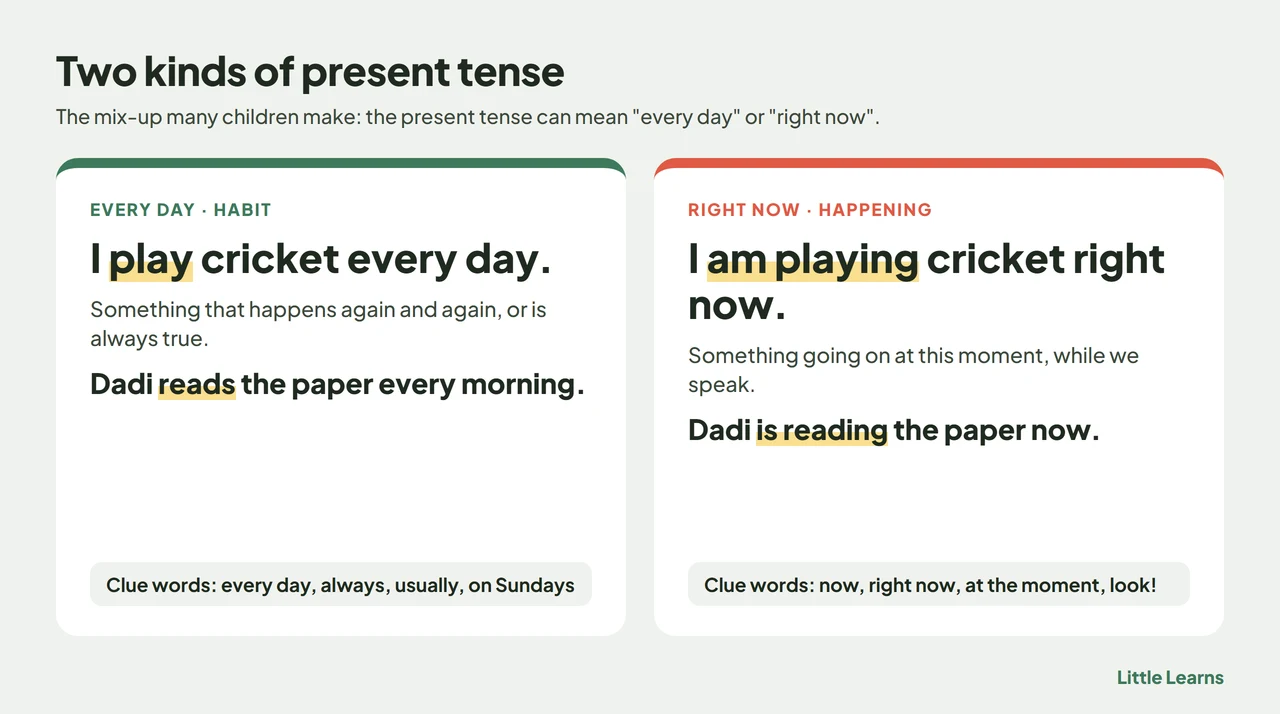
| Simple | I played cricket. | I play cricket every day. | I will play cricket. |
| “-ing” (going on) | I was playing. | I am playing right now. | I will be playing. |
Saying the tenses in Hindi as you fill the chart helps too: khela (played), khelta hai (plays), khelega (will play) follow the same past, present and future shape as English.
Notice the present column. “I play cricket” is something that happens regularly, while “I am playing” is happening right now. Mixing those two up is common, so the chart keeps them apart. The full twelve-tense table, with “had been going” and “will have gone”, can wait. In NCERT’s learning outcomes, which CBSE adopted for Classes I–VIII, Class III children are expected to tell simple past from simple present (3.E.LO9). Wider “time and tense” work is named in Class VII (7.E.LO16).
Your child’s school book may call the “-ing” forms continuous tenses: present continuous (“I am playing”) and past continuous (“I was playing”). The Hindi pair makes the difference easy to hear: जाता हूँ (jaata hoon) is “I go” every day, and जा रहा हूँ (ja raha hoon) is “I am going” right now.
Tenses chart for kids and sorting cards (printable PDF)
The six-box tenses chart above with space for your child's own sentences and a tricky-verb list, plus 24 sorting cards for yesterday, every day, now and tomorrow with an answer key. Free, ages 6–9.
How does this change with age?
- Ages 5–6: talk only. Yesterday, today and tomorrow in conversation, and lots of stories read aloud. No labels needed.
- Ages 6–8: simple past, present and future, plus the “-ing” forms (“is running”, “was running”), and the six-box chart at the end. Irregular verb collecting starts here. For “is running”, your child also needs “is”, “am” and “are”, which our guide to when to use is, am and are covers.
- Ages 8–10: keeping one tense steady through a whole story. A quick check: ask your child to retell a film or a cricket match, and listen for the verbs.
- Ages 10–12: the full twelve-tense table, now as names for patterns your child already uses.

Does teaching tenses through talk actually work?
No study has tested this exact routine, but three findings support parts of it. Children learning English master “-ing” early and the regular “-ed” ending later, as Roger Brown (1973) found. “Goed”-type slips are rare: about 2.5% of irregular pasts for the typical child in a study of 83 children by Gary Marcus and colleagues (1992). And a major review of writing research by Graham and Perin (2007), covering students in Grades 4 to 12, linked traditional grammar lessons to weaker writing, while sentence-combining practice helped.
Does Hindi help or get in the way?
Mostly it helps. Hindi marks time on the verb too (gaya tha, jaata hai, jaayega), so the idea of tense isn’t new. There’s a fun talking point too: Hindi’s kal means both ‘yesterday’ and ‘tomorrow’, and only the verb tells you which. English splits them into two words.
Two slips are especially common for Indian children. “I have seen it yesterday” is a well-known Indian English pattern. With a finished time like “yesterday”, school English wants the simple past: “I saw it yesterday.” “Did you went?” is a common learner slip everywhere. After “did”, English goes back to the base verb: “Did you go?” Our guide to common grammar mistakes Indian kids make explains more of these.
Tell your own stories in the past tense, on purpose. “When I was seven, I broke Nani’s glasses…” Children listen hardest to stories about you, and every sentence is a steady past-tense model.
पहले बातचीत, चार्ट बाद में। रोज़ पूछें: कल क्या किया? अभी क्या कर रहे हो? कल क्या करोगे? बच्चे को कहानियाँ पढ़कर सुनाएँ और अनियमित क्रियाएँ (went, saw, ate) इकट्ठा करें। ग़लती हो तो वाक्य सही करके दोहराएँ, टोकें नहीं। “goed” कहना सीखने का अच्छा संकेत है, घबराने वाली ग़लती नहीं।
“The nine- and ten-year-olds who struggle most with tenses in my classes are rarely the ones who never saw a chart. More often, they haven’t yet had much practice telling stories in English.” Monika Verma, Lead Trainer, Little Learns
Milestones from the curriculum
These milestones are adapted from the Marble skill taxonomy, an open skill-progression framework, which places them between ages 6 and 9.
Tell you about yesterday using past-tense verbs without switching to the present halfway
Use “-ing” forms correctly: “was running”, “is jumping”
Use common irregular pasts (went, saw, ran, told) instead of “goed” or “seed”
Change a sentence from past to present, or back again, when you ask
Parents also ask
- Brown, R. (1973). A First Language: The Early Stages. Harvard University Press (retrieved September 2026)
- Marcus, G. F., Pinker, S., Ullman, M., Hollander, M., Rosen, T. J., & Xu, F. (1992). Overregularization in language acquisition. Monographs of the Society for Research in Child Development, 57(4) (retrieved September 2026)
- Graham, S., & Perin, D. (2007). Writing Next: Effective strategies to improve writing of adolescents in middle and high schools. Carnegie Corporation of New York (retrieved September 2026)
- NCERT Learning Outcomes (Elementary 2017; Secondary 2019), coded edition by DERT Meghalaya, 2021: English, Classes I–X (retrieved September 2026)
- CBSE. Circular Acad-05/2019: Learning Outcomes for Classes I–VIII (retrieved September 2026)
- Marble Skill Taxonomy (v1), Generative Spark, Inc. Past, present and progressive tense; irregular past tense. Content CC BY-SA 4.0; database ODbL 1.0 (retrieved September 2026)
Every child develops at their own pace — see our learning-outcomes note. The ages above are typical ranges; plenty of children take longer.
Does Speaking Hindi at Home Affect Your Child’s English Grammar?
12 min read
Why Does My Child Skip ‘A’, ‘An’ and ‘The’? How to Teach English Articles to Hindi-Speaking Kids
10 min read
How to Teach English Grammar to Kids: Hear It, Say It, Build It, Name It
18 min read
Is, Am or Are? How to Teach Your Child Which One to Use
9 min readExplore the Journal
Teaching Your Child English Grammar
The grammar-at-home series: how children really learn grammar, and what to do about the everyday mistakes Indian children make. 6 articlesTeaching Your Child to Read
The phonics-first pillar series: how reading actually happens, and how to support it at home. 23 articlesGet one useful tip a week
Written by Monika. No spam, no daily emails — just what's worth your five minutes.