High-Utility Letters: Why You Should Teach S, A, T, P Before B, C, D
Almost no structured phonics programme teaches letters A, B, C, D. Here is why Jolly Phonics and the UK's own framework both start with S, A, T, P instead, and how to run the same sequence at home.
- Jolly Phonics and the UK's own phonics framework both start with S, A, T, P, independently, not by coincidence.
- Those letters build real, blendable words almost immediately; the first six alphabet letters barely do.
- Letters that look or sound alike, like b and d, are deliberately taught groups apart.
- No single sequence is scientifically "the best," but front-loading high-utility letters is sound, well-supported design.
Most alphabet charts go A, B, C, D — but almost no structured phonics programme actually teaches letters in that order. Jolly Phonics starts with s, a, t, p, i, n. The UK government’s own “Letters and Sounds” framework starts with s, a, t, p, independently arriving at nearly the same set. See where it fits in our guide to teaching a child phonics — here’s the actual reasoning behind the order, not just what the order is.
Why not just start with A, B, C, D?
Because a beginner reader needs to build and blend real words almost immediately, and the first six letters of the alphabet don’t let them. With only a, b, c, d, e, f you can’t build “cat,” “sat,” “pin,” or “tan” — you’re stuck reciting letters with nothing to read yet. Letters chosen for high-frequency, high-blend-potential are the fix: start with the handful that combine into the most real words the fastest, and save strict alphabetical order for later, when it’s genuinely useful — for the alphabet song, dictionaries, and filing names.

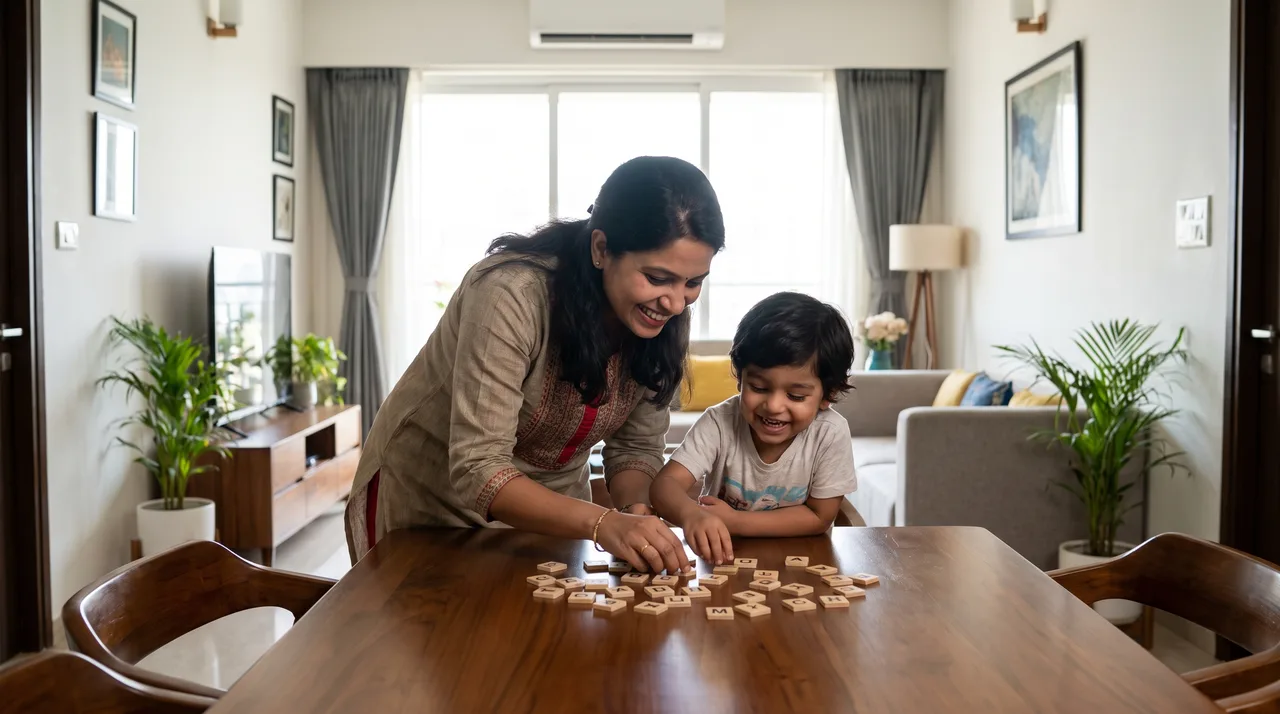
No kit required — magnetic letters, letter tiles, or even hand-written cards on paper all work.
Start with just four letters: s, a, t, p. Don’t add a fifth until your child produces each sound instantly, not just recognises the letter.
One rule: teach the sound, not the letter name, first. “This says /s/” — not “this is called ess.”
What’s the actual reasoning behind S, A, T, P?
Two independently designed programmes converge on almost the same starting four letters. Jolly Phonics’ own teacher’s guide opens with s, a, t, p, i, n, “chosen for high word-blending potential.” The UK Department for Education’s Letters and Sounds framework opens its Phase 2 with s, a, t, p as Set 1 — a government body and a commercial programme, designed separately, landing on nearly the same four letters. That’s not a coincidence of branding; it’s the same underlying logic showing up twice.
- Almost no real 3-letter words buildable from the first six letters
- Optimised for reciting the alphabet, not for decoding
- Confusable letters like *b* and *d* sit right next to each other
- Real words within days: at, sat, tap, pin, nip, tan
- Optimised for blending — the actual skill being taught
- Confusable letters are deliberately kept apart, introduced groups apart
Why are confusable letters like B and D kept apart?
This is deliberate, not incidental. Jolly Phonics places b and d two full groups apart in its sequence — never taught close together. Reading researcher Timothy Shanahan, a former member of the U.S. National Reading Panel, makes the same point independent of any single programme: “letters that are visually or phonemically similar need to be kept separated,” since teaching them side by side invites exactly the mix-ups a parent worries about. It’s a small design choice with an outsized effect on how confident early reading feels.
What does a real teaching sequence look like?
- Week 1 — s, a, t
Introduce the three sounds, then blend: at, sat. Say the sound, never the letter name, when reading.
- Week 2 — add p, then i, n
Each new letter unlocks several more real words: tap, pat, sap, pin, nip, tin, ant, pan. Review yesterday’s letters before adding a new one.
- Week 3 — the next group
Move to c, k, e, h, r, m, d — noting that *d* is placed away from *b*, which won’t appear until a later group still.
- Ongoing — one new letter only once the last is instant
If two letters start blurring together (commonly *b*/*d* later on), pause and don’t introduce the second one yet.
Does this mean my child skips the rest of the alphabet?
No — all 26 letters and their names still matter, for spelling, the alphabet song, and using a dictionary later. This is a sequence for decoding, not a shortcut around the alphabet. It’s also worth being honest about the limits of this claim: Shanahan is explicit that no single letter sequence has been proven scientifically superior to every other — the original National Reading Panel found roughly eighteen differently-sequenced phonics programmes all worked, as long as the teaching was systematic rather than incidental. The defensible claim isn’t “S-A-T-P is the one true order.” It’s narrower and still solid: front-loading high-frequency, blendable, non-confusable letters is sound design, and several independently-built programmes converge on it — while strict alphabetical order isn’t built for this job at all.

How does this change as my child gets older?
By age six or seven, most children have moved well past needing this sequencing — they’re decoding fluently enough that letter order stops mattering day to day. Starting structured and early does make a measurable difference, though: a major U.S. review of reading research found systematic phonics instruction produced meaningfully better results when it began early, in kindergarten or first grade, than when the same instruction started later. The sequence matters most in the first few months — after that, it’s exposure and practice doing the work.
If your child already knows the alphabet song, nothing is “ruined” — it’s a separate, useful skill for later. Just keep sound-teaching and name-reciting as two different activities, and always ask “what does it say?”, never “what’s it called?”, when you’re reading together.
“Parents worry they’ve done it wrong if their child already sings the alphabet song before we start. They haven’t — it’s actually the most common starting point I see in demo classes, and it’s completely recoverable. We just add a second column: the letter has a name, and separately, a job.” Monika Verma — Lead Trainer, LittleLearns
Quick answers
Produce the sound instantly for each letter in the current group, not just recognise the letter
Blend three known sounds into a real word without help
Tell you a sound is a letter’s “job,” separately from its name
Move to a new letter only after the last one is automatic, not rushed
- Jolly Learning. Letter Sounds Recognition (Jolly Phonics Teacher’s Guide) (retrieved September 2026)
- Department for Education and Skills, UK (2007). Letters and Sounds: Principles and Practice of High Quality Phonics (retrieved September 2026)
- Shanahan, T. Putting on your underwear first: why instructional sequence doesn’t always matter. Shanahan on Literacy (retrieved September 2026)
- National Institute of Child Health and Human Development. Report of the National Reading Panel: Teaching Children to Read (2000) (retrieved September 2026)
- GOV.UK. List of phonics teaching programmes validated as systematic synthetic phonics (retrieved September 2026)
Every child develops at their own pace — see our learning-outcomes note. This sequence is a teaching approach we use in class, not the only order that works — every structured phonics programme gets children reading, just by a different path.
Early Signs of Dyslexia in Preschoolers: What to Look for Beyond Reading
8 min readHeart Words: How to Teach Words That Can’t Be Sounded Out
9 min read
Reading Aloud: Why Quizzing Your Child Can Backfire at Storytime
9 min read
The Word Gap: What “30 Million Words” Gets Right, and Wrong
12 min readExplore the Journal
Teaching Your Child English Grammar
The grammar-at-home series: how children really learn grammar, and what to do about the everyday mistakes Indian children make. 6 articlesTeaching Your Child to Read
The phonics-first pillar series: how reading actually happens, and how to support it at home. 23 articlesGet one useful tip a week
Written by Monika. No spam, no daily emails — just what's worth your five minutes.