Reading Aloud: Why Quizzing Your Child Can Backfire at Storytime
"Ask your child questions while you read" curdles easily into a page-by-page quiz. Interactive questioning works; closed, right-answer quizzing doesn't. Here's the difference, and five swaps for storytime.
- Questions during storytime aren't the mistake - dialogic reading is built on questions and it works.
- The mistake is test-tone quizzing: closed right-answer questions, a quiz pace, correcting, breaking the story.
- Comment more than you question, go open not closed, follow the child's lead, welcome re-reads.
- Move comprehension checks to later and low-stakes, not mid-page.
The most common reading-aloud mistake starts as good advice: ask your child questions as you read. Mostly that helps — questions aren’t the problem, a particular style of questioning is. It curdles into “What colour is the dog? How many ducks? What’s that letter?” fired off after every page, each with one right answer, until the book is a test and the child is squirming. That version of reading aloud does more harm than good. This post is the language-and-motivation side of learning to read; the decoding side is in our phonics-first guide.
The short answer
Asking questions during a read-aloud isn’t the mistake. One of the best-evidenced things a parent can do — dialogic readingA back-and-forth style of shared reading: the adult prompts the child to talk about the book, listens, adds to what the child says, and repeats. Built on open-ended prompts, not right-answer questions. Studied since the 1980s and shown to speed expressive vocabulary growth, especially in two- and three-year-olds. — is built entirely on questions. The mistake is a particular style: closed questions with one right answer, asked at a quiz pace after every page. It means correcting the child, and cutting into an absorbing story to check they were listening. The fix isn’t to stop talking. It’s to make the talk a conversation about the book instead of an exam on it.
Isn’t asking questions the recommended thing?
Yes — the right kind. Since Whitehurst and colleagues’ work in the late 1980s, researchers have studied a style where the adult prompts, the child talks, the adult builds on the answer and loops back. Children read to this way pull ahead on spoken vocabulary and grammar. Mol and colleagues, pooling nine studies, put the added boost to expressive vocabulary at a moderate size — real, worth doing, not miraculous. The prompts that carry it are open: “What’s happening here?” “Why do you think she did that?” “Has that ever happened to you?” What they’re not is a string of label-hunting questions with the answer sitting in the picture.
What does “quizzing” look like, and why does it backfire?
Quizzing is closed questions with a known answer — “What colour is the dog?” when the dog is plainly brown — asked at a test pace, often with a correction when the child is wrong or vague. It tends to interrupt the story at its most gripping. In studies of shared reading, children’s engagement is higher when they have some control — choosing the book, turning pages, starting the comments — and lower when an adult takes the wheel and interrogates. Enjoyment isn’t a soft extra. Children who come to read for pleasure make more progress in vocabulary across the school years than children who rarely read. Reading enjoyment has also been falling: in one international survey, PISA, it dropped between 2009 and 2018. That survey is teenagers, not toddlers — background, not proof about storytime — but the direction is worth noticing.
- “What colour is his hat? How many apples? What did the boy say on the last page? No — try again.” Right answers, test tone, story stalled. The child stops volunteering anything.
- “Oh no — look at his face. What do you think just happened?” … “He looks scared to me too. What would you do?” You comment, you wonder aloud, you leave gaps. The child leans in because there’s nothing to get wrong.
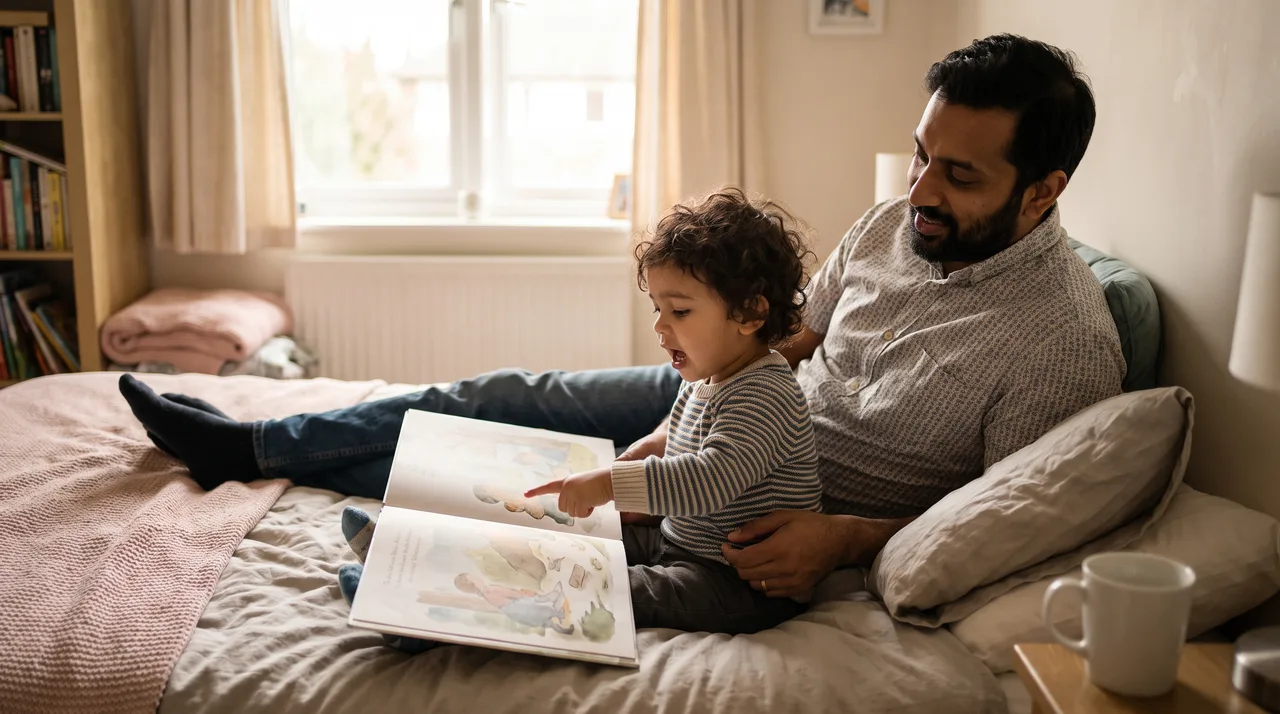
What should you do instead?
Small swaps, made a few times per book, not every page. Comprehension questions aren’t banned — they’re just moved: ask them later, at dinner, low-stakes, or not at all if the story landed. During the read:
- Comment before you question. “That bird looks lost.” Then wait. A statement gives your child something to agree with, argue with, or add to.
- Open, not closed. Trade “What colour is it?” for “What’s going on here?” or “Why do you think that happened?”
- Follow their lead. If your child points at the tractor, talk about the tractor — don’t drag them back to your planned question about the farmer.
- Welcome the re-read. The fifth reading of the same book isn’t wasted. Repetition is how vocabulary and confidence build. “We already read that” is the real mistake.
- Move the comprehension check. “What was the story about?” belongs after the book, once, gently — or at bedtime tomorrow. Not mid-page.
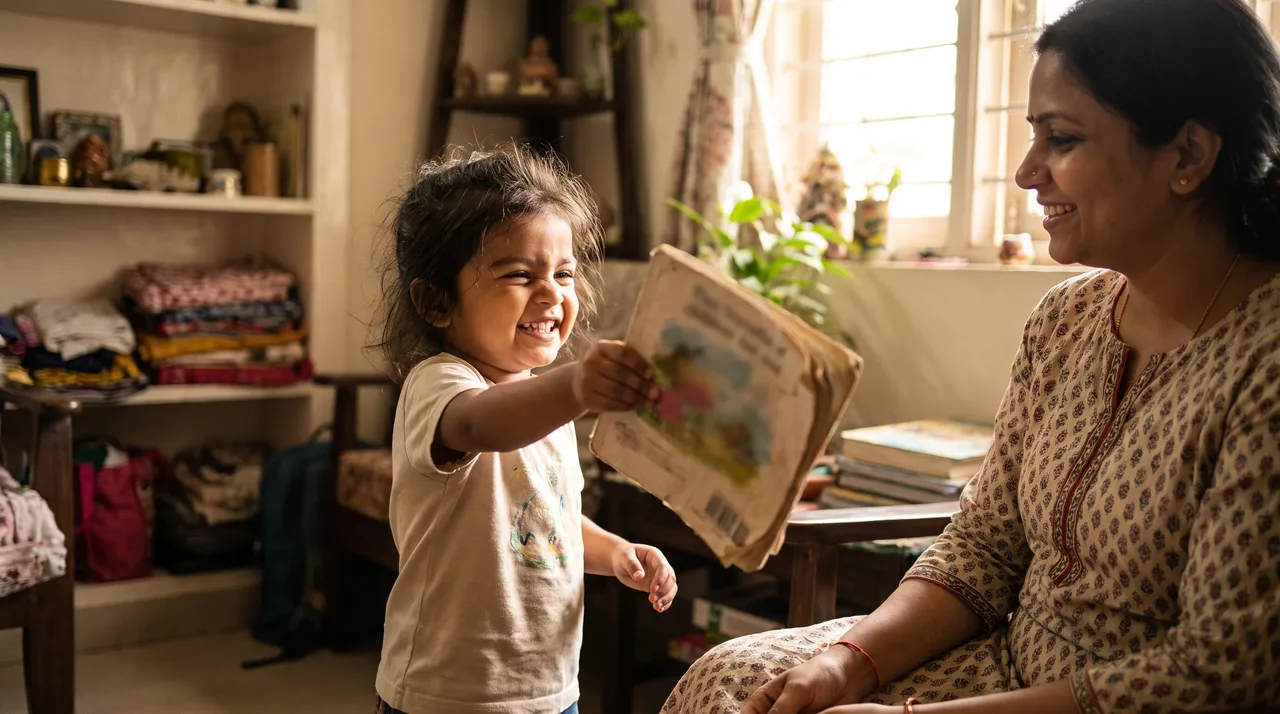
Does the age of the child change this?
Yes. The interactive style gives the biggest lift to two- and three-year-olds, and less to four- and five-year-olds and to children already finding language hard. With a toddler, you’ll do more of the prompting and expanding. With an older preschooler, ease off — more of the talk can come from them, and your job shifts to listening and occasionally deepening it. Either way, follow the child in front of you rather than a fixed script of prompts.
How does reading aloud work in an Indian home?
Read and talk in the language you’re most fluent in; the back-and-forth is what matters, not which language it happens in. Switching around an English picture book — “यह क्या है? a kite — पतंग!” — is fine. If books are scarce, told stories do the same work: panchatantra, folk tales, a grandparent’s account of a festival. The “has this ever happened to you?” prompt maps naturally onto oral storytelling. One thing to resist: the pull to turn storytime into a lesson — flashcards, “what did you learn?”, letter drills on the page. India’s ASER “Early Years” survey found that a child’s ability to talk about a picture tracks with school readiness better than recitation does. Keep any print-teaching light; our post on labels and print awareness is where that belongs.
The children I see refusing storytime are almost never bored of books. They’re tired of being tested on them — a question after every page, a gentle “no, look again” when they guess. My first instruction to those families is always the same: two weeks of reading with no questions at all. Just the story, and the odd “ooh, I didn’t see that coming.” The child comes back to books first. Then we add the wondering back, slowly.
Monika Verma — Lead Trainer, LittleLearns
Ask Mrs. Monika: quick answers
- Whitehurst, G. J., et al. (1988). Accelerating language development through picture book reading. Developmental Psychology, 24(4), 552-559. Evidence review linked: What Works Clearinghouse, Dialogic Reading (retrieved September 2026)
- Mol, S. E., Bus, A. G., de Jong, M. T., & Smeets, D. J. H. (2008). Added value of dialogic parent-child book readings: a meta-analysis. Early Education and Development, 19(1), 7-26 (retrieved September 2026)
- Bus, A. G., van IJzendoorn, M. H., & Pellegrini, A. D. (1995). Joint book reading makes for success in learning to read: a meta-analysis. Review of Educational Research, 65(1), 1-21 (retrieved September 2026)
- Deshmukh, R. S., et al. (2019). Teachers’ use of questions during shared book reading: relations to child responses. Early Childhood Research Quarterly, 49, 59-68 (retrieved September 2026)
- Sullivan, A., & Brown, M. (2015). Reading for pleasure and progress in vocabulary and mathematics. British Educational Research Journal, 41(6), 971-991 (retrieved September 2026)
- OECD (2019). PISA 2018 Results (Volume III): What School Life Means for Students’ Lives (retrieved September 2026)
- ASER Centre / Pratham (2020). Annual Status of Education Report (Rural) 2019: ‘Early Years’ (retrieved September 2026)
Every child develops at their own pace — see our learning-outcomes note. If storytime has stopped being fun, a free 20-minute demo class is a good place to reset it.
Early Signs of Dyslexia in Preschoolers: What to Look for Beyond Reading
8 min readHigh-Utility Letters: Why You Should Teach S, A, T, P Before B, C, D
8 min readHeart Words: How to Teach Words That Can’t Be Sounded Out
9 min read
The Word Gap: What “30 Million Words” Gets Right, and Wrong
12 min readExplore the Journal
Teaching Your Child English Grammar
The grammar-at-home series: how children really learn grammar, and what to do about the everyday mistakes Indian children make. 6 articlesTeaching Your Child to Read
The phonics-first pillar series: how reading actually happens, and how to support it at home. 23 articlesGet one useful tip a week
Written by Monika. No spam, no daily emails — just what's worth your five minutes.