Sportscasting for Parents: Narrating Your Day to Grow Your Child’s Words
Narrating your day - "now I'm chopping the onions" - is good advice that's easy to do badly. The research is clear that back-and-forth turns matter more than a one-way stream of words. Here's how to narrate so it counts.
- Narrating your day pours words in, but back-and-forth turns matter more than the volume of words.
- A commentary your child can't reply to lands closer to background talk.
- Narrate, pause, follow what your child gives you, build on it, hand the turn back.
- Do it in the language you speak most richly - a vivid Hindi narration beats a thin English one.
“Now I’m peeling the potatoes. The water’s getting hot. I’m putting them in — careful, steam.” Narrating your day out loud, so your child hears a running stream of words tied to what’s happening, is one of the most repeated pieces of early-language advice. Some parents know it as sportscasting; speech therapists call the same habit self-talk and parallel talk. It’s genuinely useful. It’s also easy to do in a way that does very little. This post is the oral-language side of learning to read; the sound-and-letter side is in our phonics-first guide.
The short answer
Narrating what you’re doing is a good way to pour more language into an ordinary moment. But the research is clear that back-and-forth conversational turnsA turn is one person speaking and the other responding on the same topic — an exchange, not a broadcast. Even a babble or a point counts as a child’s turn. Turns predict language growth more strongly than the sheer number of words a child hears. matter more than the sheer volume of words. A non-stop commentary that never pauses for your child is closer to background talk, which is the weaker ingredient. The skill is using narration to start an exchange: say something, wait, notice what your child does, build on it, hand the turn back.
Narration is bait for a conversation, not a performance to get through
Pause often. Your child’s reply might be a word, a look, a point — all of those are turns
What counts as “good” narration changes with age: richer words for toddlers, talk about the not-here for preschoolers
Do it in the language you speak most easily and expressively
Does narrating your day actually grow vocabulary?
It can, with a catch about which part does the work. Romeo and colleagues recorded the home talk of 36 children aged 4 to 6, then scanned their brains during story listening. Children who’d had more conversational turns showed stronger activity in a key language region, and that brain difference statistically explained much of the link between turns and verbal skill — regardless of family income or how many words the children heard overall. Zimmerman and colleagues, using automated recordings in 275 homes, put a number on it: back-and-forth exchanges were about six times more strongly tied to language development than adult word count alone. Both studies are observational — a link, not proof that adding turns causes the gain — but the pattern is consistent.
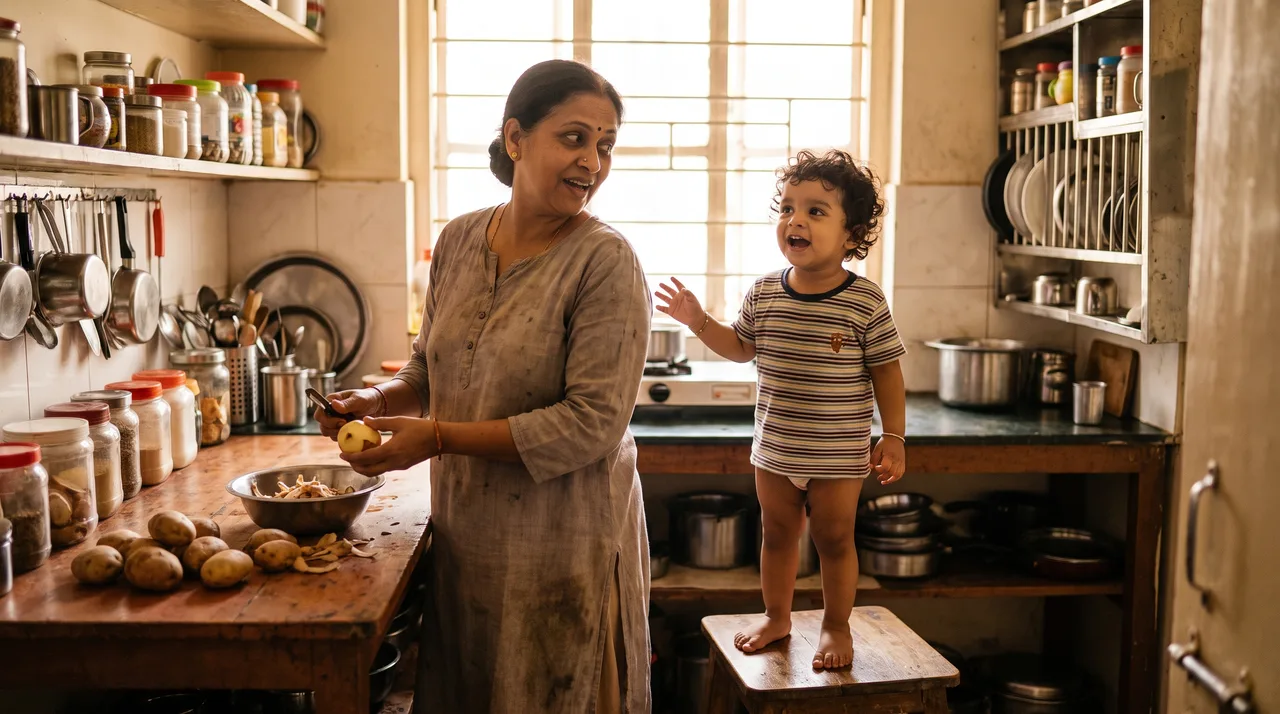
Why do turns beat a running commentary?
A commentary you deliver at your child, without stopping, is mostly adult word count, the ingredient the research ranks lower. The stronger version has a shape: narrate a little, pause, watch what your child looks at or says, put words to that, then leave space for them again. A pointed finger is a turn. A single word is a turn. “Hot!” from your two-year-old is a turn you can expand: “Yes, the pan is hot. We wait for it to cool.” Now one observation has become an exchange, and the exchange is the part that predicts growth.
- “I’m washing the rice. Now I’m draining it. Now it goes in the cooker. Now I press the button.” Steady, well-meant, and gone in a stream. Your child heard words but did nothing with them.
- “I’m washing the rice — see it go cloudy? … What do you think that is?” Wait. Your child says “milk.” “Looks like milk, doesn’t it? It’s the starch coming off.” Same task, but now there’s a thread your child is holding.
Parents who’ve read the advice often arrive narrating hard: a full commentary, every task, all day. The child is usually quiet through all of it. What changes things isn’t more words. It’s the parent asking one small thing, then holding the silence until the child fills it. The quiet ones almost always do.
Monika Verma — Lead Trainer, LittleLearns
What should you say, and how does it change with age?
The features of talk that predict later vocabulary shift as a child grows. With toddlers, it’s variety and richness — using the less common word, not just “put the thing there.” With preschoolers, it’s talk that leaves the here and now: remembering, planning, explaining, wondering. “This dal is like the one at Nani’s — remember, the day it rained?” pulls your child into language about something not in front of them. Rowe’s work links that kind of talk to a stronger vocabulary a year later. One more finding worth knowing: Weisleder and Fernald found it’s speech directed to your child that counts. Conversation a child merely overhears does far less.
- Toddler, reach for rich words
Not just “fold the shirt.” “This one’s crumpled. Let’s smooth it flat, then fold the sleeves in.” Crumpled, smooth, sleeves — ordinary task, better words.
- Toddler, name and wait
Hold up a sock. “Whose is this?” Wait. Whatever they say, answer it. The waiting is the lesson.
- Preschooler, go to the not-here
“We wore these socks to the park on Sunday. What did we do there?” Now they’re talking about something that isn’t in the room.
- Preschooler, explain and wonder
“Why do you think the towels take longer to dry?” You’re not testing — you’re modelling how to reason out loud, and inviting them to try.

Which language should I narrate in?
The one you’re most fluent and expressive in. Varied vocabulary and talk about the non-present are far easier to deliver in your strongest language — a vivid narration in Hindi, Marathi or Tamil does more than a hesitant, simplified one in English. Mixing languages in a sentence — “अब मैं batter को fold कर रही हूं” — is normal in multilingual homes and isn’t linked to language delay. The mechanism underneath, a child and adult attending to the same thing while the adult talks about it, doesn’t depend on a single language.
A joint-family home is built for this. More adults means more chances for turns, as long as they’re talking to your child, not only to each other. A grandparent’s folk tale in Awadhi and a parent’s follow-up questions in Hindi build one shared pool of language.
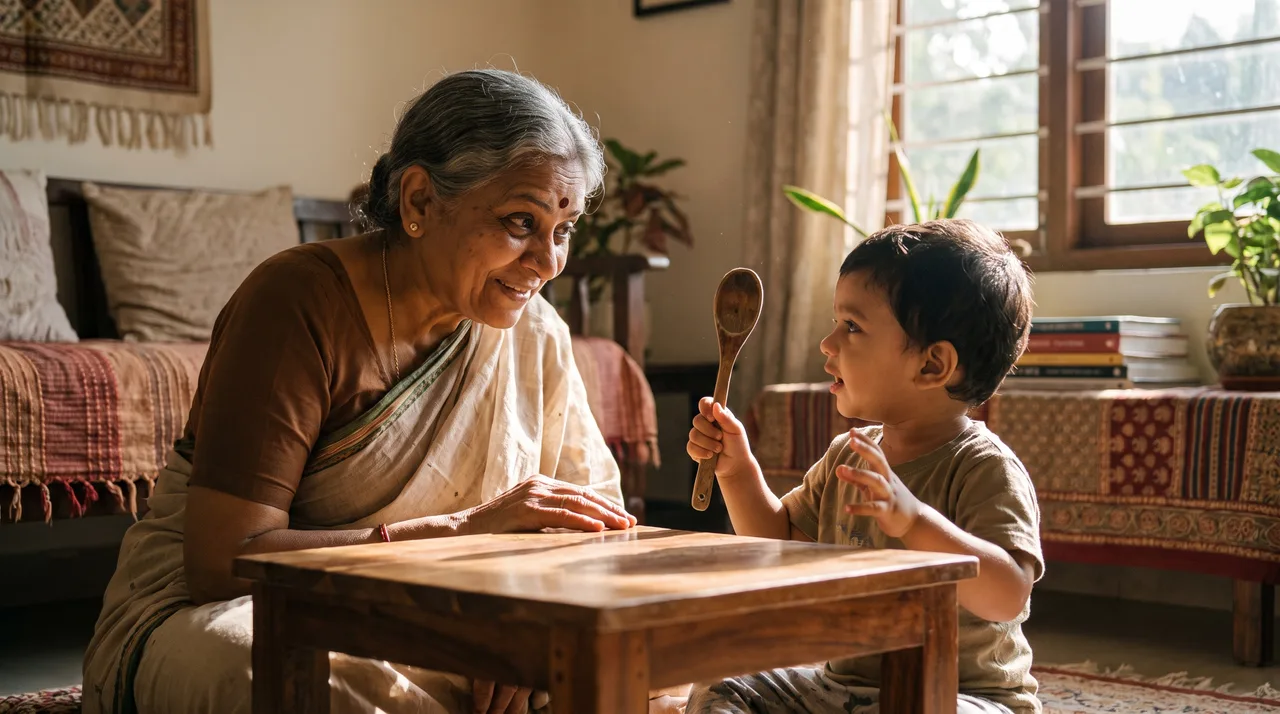
What can’t narration do?
It’s not a word-count target — the exchanges matter, not the tally. It’s not a fix for screen time, and it’s not a test of whether you’re a “talkative enough” parent; a quieter parent who has a few real back-and-forth moments a day is doing the thing that counts. And the payoff sits on the comprehension side of reading: a strong oral vocabulary helps a child understand what they read. It doesn’t replace the separate job of teaching them to decode — see our honest look at the “word gap” for where this evidence is solid and where it’s oversold.
Milestones from the curriculum
Take several back-and-forth turns with you on one topic, not just one exchange
Use words for things not physically present — yesterday, later, the park
Answer a simple “why” question with a reason, even a wrong one
Retell a short real event in the right order
These oral-language skills feed reading comprehension later. They sit alongside, not instead of, the sound-and-letter work — our phonics versus phonemic awareness post explains how the two strands run together, and what labels around the house do covers the print-awareness piece.
Parents also ask
- Romeo, R. R., et al. (2018). Beyond the 30-million-word gap: children’s conversational exposure is associated with language-related brain function. Psychological Science, 29(5), 700-710 (retrieved September 2026)
- Zimmerman, F. J., et al. (2009). Teaching by listening: the importance of adult-child conversations to language development. Pediatrics, 124(1), 342-349 (retrieved September 2026)
- Rowe, M. L. (2012). A longitudinal investigation of the role of quantity and quality of child-directed speech in vocabulary development. Child Development, 83(5), 1762-1774 (retrieved September 2026)
- Weisleder, A., & Fernald, A. (2013). Talking to children matters: early language experience strengthens processing and builds vocabulary. Psychological Science, 24(11), 2143-2152 (retrieved September 2026)
- Hoff, E. (2003). The specificity of environmental influence: socioeconomic status affects early vocabulary development via maternal speech. Child Development, 74(5), 1368-1378 (retrieved September 2026)
- Demir-Lira, O. E., & Rowe, M. L. (2013). Decontextualized language input and preschoolers’ vocabulary development. Seminars in Speech and Language, 34(4) (retrieved September 2026)
- National Early Literacy Panel (2008). Developing Early Literacy: Report of the National Early Literacy Panel (retrieved September 2026)
- Cambridge Handbook of Childhood Multilingualism (2023), ch. 8: Code-switching among bilingual and trilingual children (retrieved September 2026)
Every child develops at their own pace — see our learning-outcomes note. If you’d like a read on which language strand to focus on next, that’s part of the free 20-minute demo class.
Early Signs of Dyslexia in Preschoolers: What to Look for Beyond Reading
8 min readHigh-Utility Letters: Why You Should Teach S, A, T, P Before B, C, D
8 min readHeart Words: How to Teach Words That Can’t Be Sounded Out
9 min read
Reading Aloud: Why Quizzing Your Child Can Backfire at Storytime
9 min readExplore the Journal
Teaching Your Child English Grammar
The grammar-at-home series: how children really learn grammar, and what to do about the everyday mistakes Indian children make. 6 articlesTeaching Your Child to Read
The phonics-first pillar series: how reading actually happens, and how to support it at home. 23 articlesGet one useful tip a week
Written by Monika. No spam, no daily emails — just what's worth your five minutes.