Labeling Household Objects: Does Taping Words to the Fridge Help Reading?
Every parenting site says to tape word labels on the furniture. The evidence is narrower than the tip: labels can build print awareness, but only if you stop and talk about them - and they won't teach decoding or grow vocabulary the way it's often claimed.
- The tip: label the house and your child starts reading. The evidence: they don't.
- Children "read" familiar labels by place and colour, not letters — scramble the letters and they don't notice.
- What labels can do, talked about, is nudge print awareness — and only that.
- A two-script label (Hindi and English on one card) does one thing a single-script one can't.
Here’s a tip every parenting site repeats: labelling household objects — writing “door,” “chair,” “table” on sticky notes and taping them up — will get your child reading. It’s cheap, it feels productive, and it has been passed around for decades. It also doesn’t do what the tip claims. This post is the language-and-print side of learning to read; the decoding side is our phonics-first guide.
The short answer
Taping words to furniture doesn’t teach a child to decode, and it rarely teaches new vocabulary, because the words parents label are ones a child already knows. What labels can do is nudge print awarenessThe understanding that print carries meaning, maps onto speech, runs left to right and top to bottom, and is made of words separated by spaces. A real, measurable pre-reading skill — but one strand of readiness, not the whole of it. — and only if an adult stops and talks about them. The label on its own is wallpaper. The ten-second conversation about it is the activity. Best from about age three to six, once a child starts noticing print and asking what it says.
Where does this idea come from?
It has a grain of truth. Young children genuinely do notice environmental print — shop signs, cereal boxes, the label on a familiar jar — earlier and more eagerly than they notice print in a book, because it’s meaningful and tied to something real. Somewhere along the way that observation hardened into “surround them with words and they’ll absorb reading.” The absorbing part is where it falls apart.
What does the evidence actually show?
That recognising a word by its surroundings is a different skill from reading it. In a 1984 study by Masonheimer, Drum and Ehri, preschoolers who could confidently “read” logos like Pepsi or Stop failed to read the same words once the colour, shape and setting were stripped away. They also didn’t notice when the letters were scrambled — “Xepsi” still got read as “Pepsi.” A 2014 study by Zhao and colleagues, with different children, found the same thing. Exposure to labels and signs, on its own, didn’t turn into reading words.
What does help is an adult drawing attention to the print itself — a strategy researchers call print referencing. Pointing to letters, running a finger under a word, naming a letter, noting the space between two words: Justice and colleagues found that teachers who read this way over 30 weeks sped up young children’s print knowledge. Note what improved. Print concepts — not decoding, not comprehension.
- Put words on twenty objects and your child will start reading them, building a sight vocabulary as they go. The house does the teaching.
- A label teaches nothing by sitting there. A child “reads” it by its place and colour, not its letters. What builds print awareness is you stopping at one label, most days, and talking about it for ten seconds.
In the 1984 study, children who “read” the Pepsi logo confidently were shown the same logo with the letters scrambled to spell “Xepsi” — and most read it as “Pepsi” anyway, without noticing. They were recognising the shape and colour of the sign, not the word.
So what can labels genuinely do?
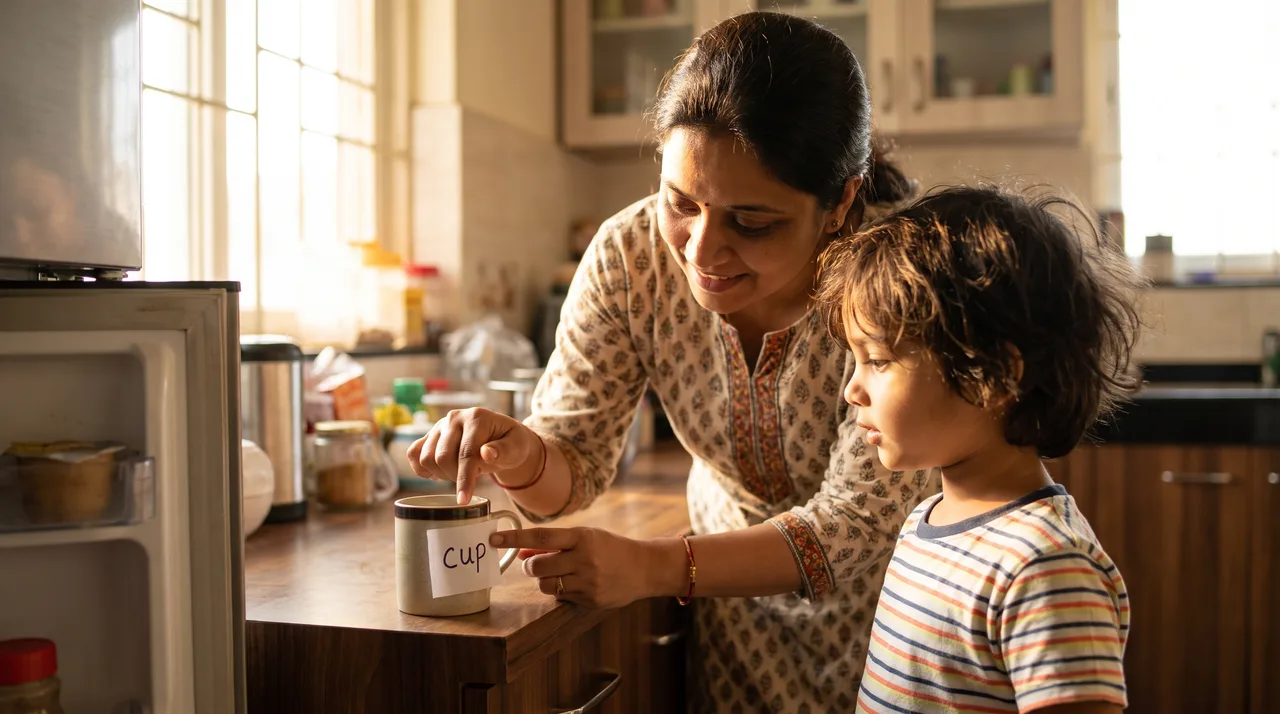
Used as talking points, a few things worth having. Run your finger under the word, left to right, as you say it — that shows print tracks speech in order. Name one letter, ideally one that’s also in your child’s name. On a two-word label, point to the gap and say “one word here, another word here” — word boundaries genuinely confuse new readers. Now and then, compare two labels: “‘door’ and ‘desk’ both start with the letter d.” Each of these is ten seconds, and none of it needs a worksheet.
One real exception on vocabulary: label something your child doesn’t already have a word for, or use the label to add one. “This is the hinge — the part that lets the door swing.” Then the label carried a new word, which is the point.
Should we label in Hindi, English, or both?
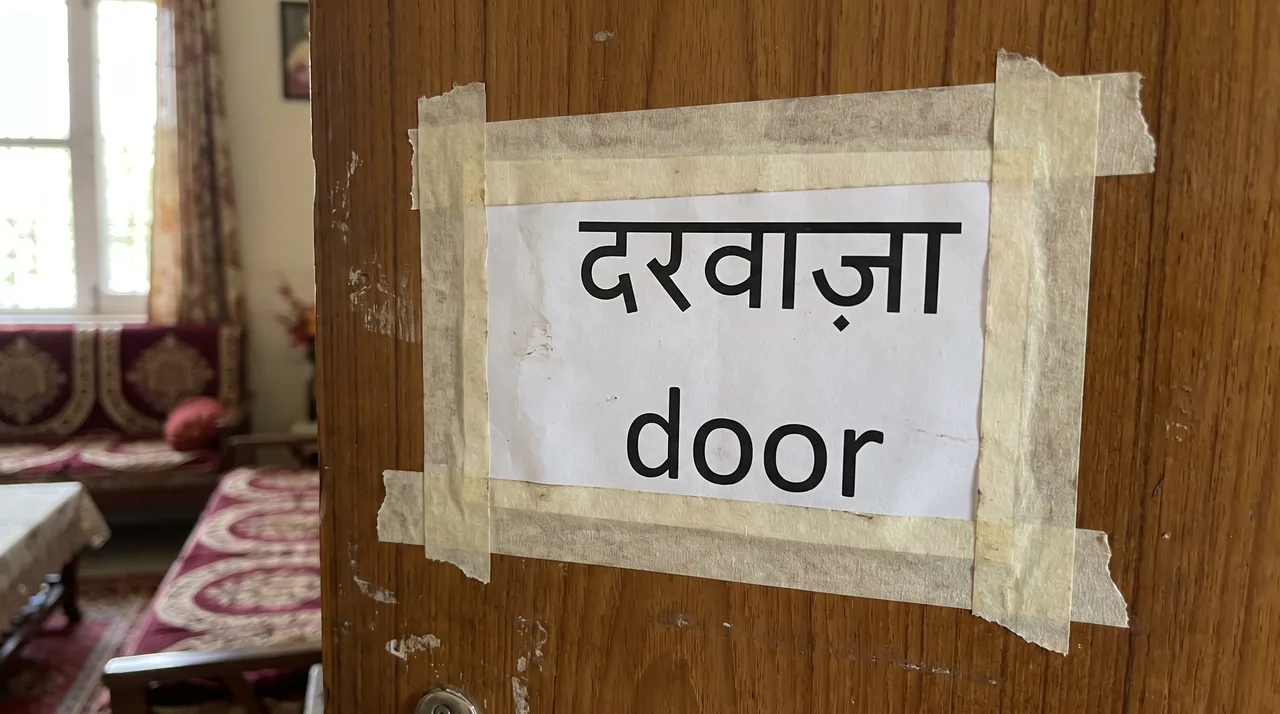
Both, on one card, has a rationale that English-only labelling lacks: incidental exposure to two scripts, and a chance for your child to see that meaning carries across writing systems. Pearson and colleagues found a bilingual child’s vocabulary is spread across their languages and, counted together, matches a monolingual child’s. One caution: “sound out the letters” is English-blog advice that doesn’t port to Hindi. In akshara scripts like Devanagari a symbol stands for a whole syllable, not just a single sound, so clap the syllables in the Hindi word instead. And you needn’t manufacture much — calendars, packets and signage already fill an Indian home with print to point at.
Every year a parent tells me, a little deflated, that they labelled the whole house and “it didn’t work.” When I ask what they did with the labels, the answer is almost always: put them up. That’s the gap. The families who get something out of labels are the ones who stop at one, most days, and talk about it for ten seconds.
Monika Verma — Lead Trainer, LittleLearns
The follow-up questions
- Masonheimer, P. E., Drum, P. A., & Ehri, L. C. (1984). Does environmental print identification lead children into word reading? Journal of Reading Behavior, 16(4), 257-271 (retrieved September 2026)
- Zhao, J., et al. (2014). Do preschool children learn to read words from environmental prints? PLOS ONE, 9(1), e85745 (retrieved September 2026)
- Neumann, M. M., Hood, M., Ford, R. M., & Neumann, D. L. (2012). The role of environmental print in emergent literacy. Journal of Early Childhood Literacy, 12(3), 231-258 (retrieved September 2026)
- Justice, L. M., McGinty, A. S., Piasta, S. B., Kaderavek, J. N., & Fan, X. (2010). Print-focused read-alouds in preschool classrooms. Language, Speech, and Hearing Services in Schools, 41(4), 504-520 (retrieved September 2026)
- Justice, L. M., & Ezell, H. K. (2004). Print referencing: an emergent literacy enhancement strategy and its clinical applications. Language, Speech, and Hearing Services in Schools, 35(2), 185-193 (retrieved September 2026)
- Pearson, B. Z., Fernandez, S. C., & Oller, D. K. (1993). Lexical development in bilingual infants and toddlers: comparison to monolingual norms. Language Learning, 43(1), 93-120 (retrieved September 2026)
- Nag, S. (2007). Early reading in Kannada: the pace of acquisition of orthographic knowledge and phonemic awareness. Journal of Research in Reading, 30(1), 7-22 (retrieved September 2026)
Reading develops at its own pace for every child — see our learning-outcomes note. If you’d rather have your child’s stage checked than guess at it, that’s part of the free 20-minute demo class.
Early Signs of Dyslexia in Preschoolers: What to Look for Beyond Reading
8 min readHigh-Utility Letters: Why You Should Teach S, A, T, P Before B, C, D
8 min readHeart Words: How to Teach Words That Can’t Be Sounded Out
9 min read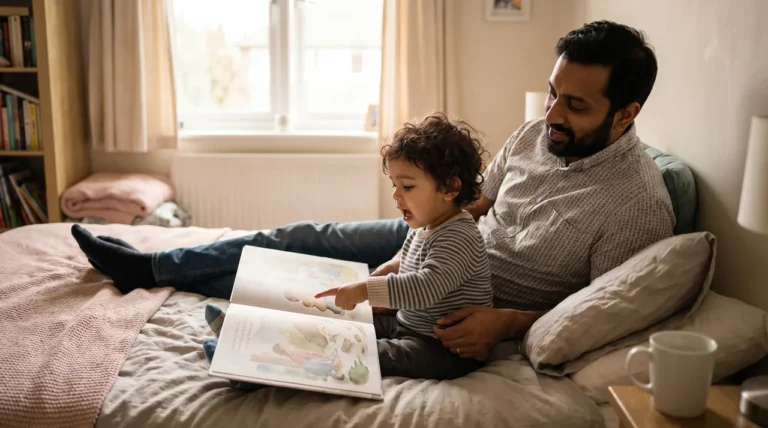
Reading Aloud: Why Quizzing Your Child Can Backfire at Storytime
9 min readExplore the Journal
Teaching Your Child English Grammar
The grammar-at-home series: how children really learn grammar, and what to do about the everyday mistakes Indian children make. 6 articlesTeaching Your Child to Read
The phonics-first pillar series: how reading actually happens, and how to support it at home. 23 articlesGet one useful tip a week
Written by Monika. No spam, no daily emails — just what's worth your five minutes.